Master’s of Education in Australia for International Students

Feb 03, 2026
Are you an international student looking to build a rewarding career in teaching, educational leadership, or academic research? A Master’s of Education in Australia offers globally recognised qualifications, advanced pedagogical knowledge, and strong career outcomes. With world-class universities, flexible specialisations, and a multicultural learning environment, Australia has become a top destination for students seeking excellence in education studies and professional growth.
In this blog, masters of Education in Australia is explored in detail to help international students make informed decisions. You’ll learn about the course structure, eligibility criteria, top universities, specialisations, admission requirements, costs, scholarships, career opportunities, and post-study work options. This guide is designed to give you a complete roadmap for studying a Master’s of Education in Australia successfully.
In this blog
What Is a Master’s of Education (MEd)?
A Master’s of Education (MEd) is a postgraduate degree designed to advance knowledge and professional skills in teaching, learning, and educational leadership across diverse education settings. It focuses on developing expertise in pedagogy, curriculum design, educational research, policy analysis, and leadership practices. The program is ideal for educators, trainers, and professionals seeking career advancement or specialisation.
An MEd in Australia combines theoretical foundations with practical applications, allowing students to address real-world educational challenges. Many programs offer flexible study options, including coursework, research, or a combination of both. Graduates gain globally recognised qualifications that open pathways into teaching roles, academic research, educational management, policy-making, and doctoral studies in education.
Why Study a Master’s of Education in Australia?
Study a Master’s of Education in Australia because the country offers globally respected education degrees, high teaching standards, and strong career outcomes for international students. Australian universities combine academic excellence with practical learning, preparing graduates for leadership roles in education worldwide. The qualification is internationally recognised and aligns with modern teaching practices and global education systems. It also provides access to post-study work opportunities and long-term career growth.
1. World-Ranked Universities for Education Studies
Australia is home to several world-ranked universities consistently featured in global QS and THE rankings for education studies. These institutions are known for cutting-edge research, innovative teaching methodologies, and experienced academic faculty. Students benefit from evidence-based learning, modern curricula, and exposure to international education frameworks. Many universities also collaborate with global education bodies, enhancing academic credibility. This global standing significantly boosts employability after graduation.
2. Strong Education System and Teaching Standards
Australia has one of the most robust and regulated education systems in the world, ensuring high-quality teaching and learning outcomes. MEd programs follow internationally benchmarked standards and focus on inclusive, student-centred education practices. Courses emphasise practical training, classroom management, and educational leadership. Students gain real-world insights through case studies, placements, and applied research. These standards prepare graduates for diverse educational environments.
3. High Demand for Qualified Education Professionals
There is a growing demand in Australia for skilled education professionals, including teachers, education consultants, and academic leaders. Population growth, policy reforms, and a focus on quality education have increased workforce needs. Graduates with a Master’s of Education are valued for their advanced pedagogical skills and leadership capabilities. The demand extends to both public and private education sectors. This creates strong job prospects during and after study.
4. Global Recognition and International Teaching Careers
An Australian Master’s of Education is globally recognised, enabling graduates to pursue teaching and education roles internationally. The degree aligns with international teaching standards, making it valuable across multiple countries. Graduates can work in international schools, higher education institutions, NGOs, and education policy organisations. The global exposure gained during the study enhances cross-cultural teaching competence. This recognition supports long-term international career mobility.
Master’s of Education in Australia for International Students
A Master’s of Education in Australia is designed to support international students seeking advanced knowledge, professional teaching skills, and global career opportunities. Australian universities offer flexible MEd programs that combine theory, research, and practical learning. The courses are internationally recognised and aligned with global education standards. Students also benefit from post-study work options and a supportive international learning environment.
1. Eligibility Criteria for International Students
International students must meet specific eligibility requirements set by Australian universities to enrol in a Master’s of Education. These typically include holding a recognised undergraduate degree from an accredited institution. Some universities may require prior teaching or education-related experience. Applicants must also meet English language proficiency standards. Additional criteria can vary depending on the institution and specialisation.
2. Academic Background Requirements
Most universities prefer applicants with a bachelor’s degree in education, humanities, social sciences, or related disciplines. However, graduates from other fields may also be considered, especially for leadership or education management specialisations. Academic transcripts are assessed to ensure sufficient foundational knowledge. Certain programs may require a minimum GPA or equivalent academic performance. Bridging courses may be offered if needed.
3. English Language Requirements (IELTS, PTE, TOEFL)
International students must demonstrate English proficiency through standardised tests such as IELTS, PTE, or TOEFL. Most universities require an IELTS score of 6.5–7.0 overall, with no band below 6.0. Equivalent scores are accepted for PTE and TOEFL. Higher requirements may apply for teaching-focused programs. English proficiency ensures effective communication and academic success.
4. Australian Student Visa (Subclass 500) Overview
International students must apply for an Australian Student Visa (Subclass 500) to study a Master’s of Education. This visa allows full-time study and limited work rights during the course. Applicants must provide a Confirmation of Enrolment (CoE), financial proof, and health insurance (OSHC). The visa is usually granted for the full course duration. It may also support post-study work pathways after graduation.
Popular Specialisations in Master’s of Education in Australia
A Master’s of Education in Australia offers a wide range of specialisations that allow students to tailor their studies to specific career goals. These specialisations focus on leadership, teaching practice, curriculum development, and inclusive education. Choosing the right specialisation helps students gain targeted expertise and improve employability. It also opens pathways to both teaching and non-teaching education roles globally.
1. Educational Leadership and Management
This specialisation prepares students for leadership roles in schools, colleges, and education organisations. It focuses on strategic planning, policy development, and organisational management in education settings. Students learn how to lead teams, manage change, and improve institutional performance. The program also develops decision-making and problem-solving skills. Graduates often pursue roles such as school leaders, academic coordinators, or education administrators.
2. Curriculum and Instruction
Curriculum and Instruction focuses on designing, implementing, and evaluating effective learning programs. Students gain in-depth knowledge of curriculum theory, teaching strategies, and assessment methods. The specialisation emphasises improving classroom practices and student learning outcomes. It is ideal for educators looking to enhance teaching quality across diverse learning environments. Graduates can work as curriculum developers, instructional designers, or senior teachers.
3. TESOL and English Language Teaching
TESOL and English Language Teaching equip students with skills to teach English to non-native speakers. The program covers language acquisition, teaching methodologies, and classroom management techniques. Students also learn how to design lesson plans for multicultural and multilingual classrooms. This specialisation is highly valued in international education contexts. Graduates can work as ESL teachers, language trainers, or academic English instructors worldwide.
4. Special Education and Inclusive Education
This specialisation focuses on supporting learners with diverse educational needs and abilities. Students learn inclusive teaching strategies, assessment techniques, and intervention methods. The program emphasises equity, accessibility, and inclusive classroom practices. It prepares educators to work with students with disabilities or learning difficulties. Graduates often find roles in special education settings, support services, or inclusive education policy roles.
5. Educational Psychology and Counselling
Educational Psychology and Counselling focuses on understanding student behaviour, learning processes, and emotional wellbeing. This specialisation equips students with skills to support learners’ academic, social, and psychological development. It covers counselling techniques, developmental psychology, and learning assessment methods. Students learn how to address learning difficulties, behavioural challenges, and mental health concerns in educational settings. Graduates can work as school counsellors, education support specialists, student wellbeing officers, or progress into further professional psychology pathways.
Top Universities Offering Master’s of Education in Australia
Australia is home to several globally ranked universities offering high-quality Master’s of Education programs for international students. These universities are known for strong education faculties, research-driven teaching methods, and industry-aligned curricula. Studying at one of the top Australian Universities provides exposure to modern pedagogy, policy development, and practical learning experiences. Graduates benefit from international recognition, strong academic support, and excellent employability outcomes. These institutions also offer diverse specialisations to match different career goals in education.
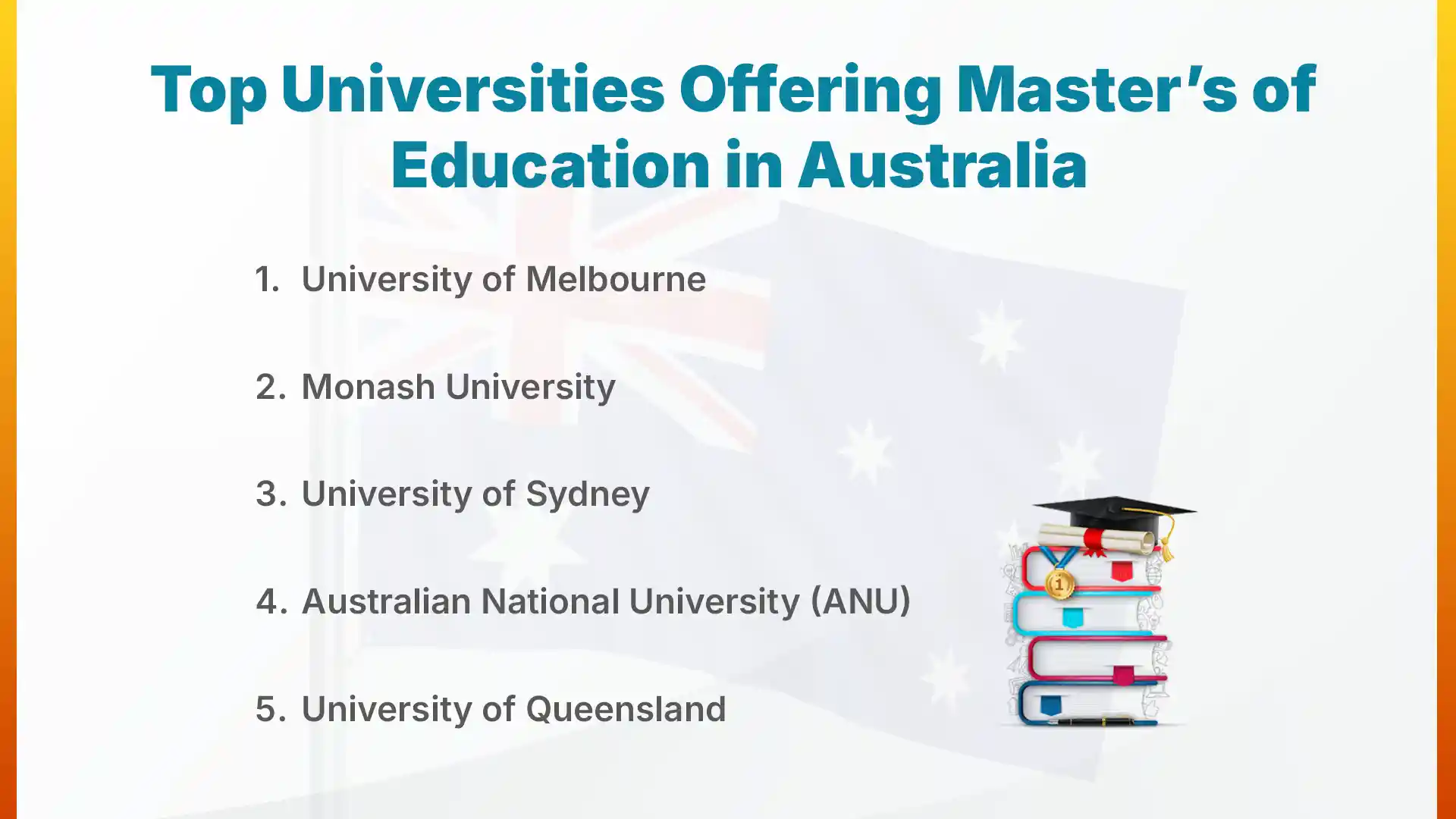
1. University of Melbourne
The University of Melbourne offers a highly respected Master’s of Education with flexible study options and diverse specialisations. The program emphasises research-informed teaching, leadership, and policy development. Students gain access to world-class faculty, modern learning facilities, and strong industry connections. The university focuses on evidence-based education practices and innovation. Graduates are well-prepared for leadership, research, and professional roles in global education systems.
2. Monash University
Monash University is renowned for its future-focused Master’s of Education programs tailored to contemporary education challenges. The curriculum integrates theory with real-world practice, leadership skills, and digital learning strategies. Students benefit from strong research opportunities and global partnerships. Monash places a strong emphasis on inclusive education and professional development. Graduates are equipped for roles across schools, higher education, and education policy sectors.
3. University of Sydney
The University of Sydney offers a comprehensive Master’s of Education designed for both aspiring educators and experienced professionals. The program provides strong foundations in curriculum design, educational research, and teaching innovation. Students engage with critical global education issues and evidence-based practices. The university’s reputation enhances international career prospects. Graduates often move into leadership, academic, and policy-related education roles.
4. Australian National University (ANU)
ANU delivers a research-intensive Master’s of Education with a strong focus on education policy, leadership, and global education systems. The program is ideal for students interested in academic research or government and policy roles. ANU’s close links with national and international organisations provide valuable exposure. Students develop strong analytical and research skills throughout the course. Graduates are highly regarded in education research and policy-making careers.
5. University of Queensland
The University of Queensland offers a well-structured Master’s of Education, emphasising innovation, teaching excellence, and leadership. The program blends theoretical knowledge with practical applications in diverse educational contexts. Students benefit from a strong research culture and modern learning environments. UQ focuses on developing adaptable and globally competent education professionals. Graduates pursue successful careers in teaching, leadership, research, and international education sectors.
Course Structure and Duration of Master’s of Education in Australia
The Master’s of Education in Australia is designed to provide both theoretical depth and practical expertise in education. Programs are structured to suit graduates from diverse academic and professional backgrounds. Students can customize their studies through specializations, electives, and research components. The flexible structure allows international students to align the degree with career goals in teaching, leadership, research, or education policy.
1. Course Duration (1–2 Years Full-Time)
The duration of a Master’s of Education in Australia typically ranges from one to two years, depending on prior qualifications and experience. Students with a relevant educational background may qualify for accelerated pathways. Part-time study options are also available for flexibility. Program length can vary by specialization and research components. This structure allows students to balance academic depth with timely graduation.
2. Core Subjects, Electives, and Specialisations
The course includes core subjects covering educational theory, pedagogy, curriculum design, and assessment. Students can choose electives to deepen expertise in areas such as leadership, TESOL, or inclusive education. Specializations help tailor the degree to specific career paths. The curriculum reflects current global education trends and best practices. This flexibility ensures relevant and career-focused learning outcomes.
3. Research Projects, Teaching Practicum, and Internships
Most programs include research projects or a minor thesis to develop analytical and academic writing skills. Teaching practicum or professional placements provide hands-on classroom or organizational experience. Internships allow students to apply theoretical knowledge in real-world education settings. These components strengthen practical competence and employability. Graduates gain valuable experience that supports career advancement in the education sector.
How to Apply for a Master’s of Education in Australia?
To apply for a Master’s of Education in Australia, you must carefully plan your university selection, meet academic and English requirements, and complete both university and visa applications on time. The process is straightforward but requires proper documentation and clear career goals. International students should start early to meet deadlines and increase admission success. Following a step-by-step approach to obtaining an Australian student visa makes the application smooth and stress-free.
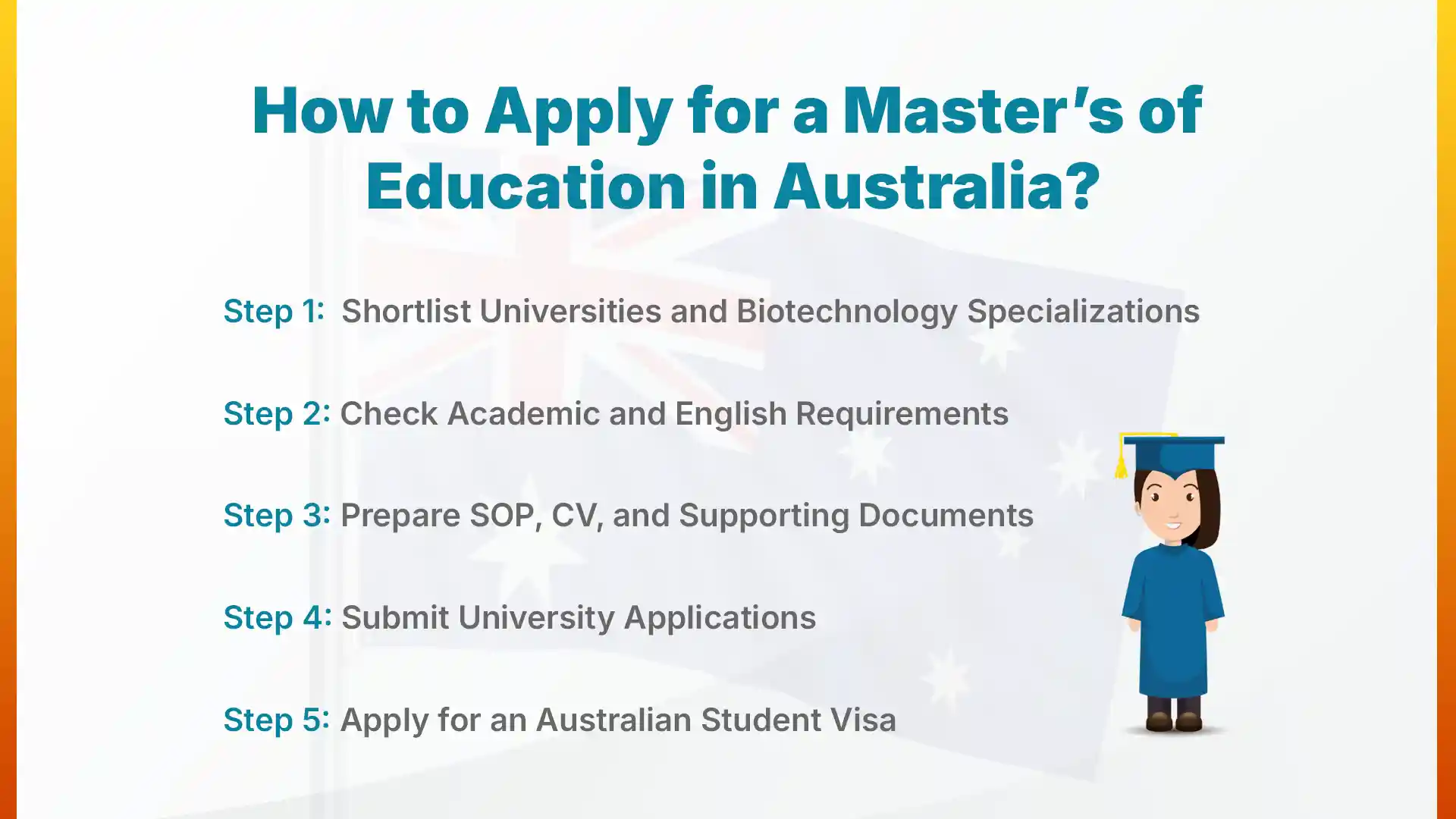
Step 1: Shortlist Universities and Education Specialisations
Begin by researching Australian universities offering a Master’s of Education and identify specializations that match your career goals. Consider factors like course content, duration, entry requirements, and future career scope. Compare universities based on rankings, teaching focus, and research opportunities. Ensure the program aligns with your academic background. Shortlisting wisely improves admission and career outcomes.
Step 2: Check Academic and English Requirements
Review the academic eligibility criteria, including minimum bachelor’s degree requirements and relevant study background. Check English language requirements, such as IELTS, PTE, or TOEFL scores. Some universities may offer waivers based on prior education in English. Always confirm score validity and minimum band requirements. Meeting these criteria is essential for offer approval.
Step 3: Prepare SOP, CV, and Supporting Documents
Prepare a strong Statement of Purpose explaining your motivation, academic interests, and career goals in education. Update your CV with relevant academic, teaching, or professional experience. Gather transcripts, certificates, references, and work experience letters if applicable. Well-prepared documents significantly improve your admission chances. Clarity and consistency are key.
Step 4: Submit University Applications
Submit applications through university portals or authorized representatives before deadlines. Double-check all details to avoid errors or missing documents. Some universities may charge an application fee. Track your application status regularly. Timely submission increases the likelihood of early offers.
Step 5: Apply for an Australian Student Visa
After receiving an offer letter and Confirmation of Enrolment (CoE), apply for the Australian Student Visa (Subclass 500). Prepare financial proof, health insurance, and genuine student documents. Ensure all information is accurate and complete. A successful visa application allows you to legally study and work in Australia.
Admission Requirements for Master’s of Education in Australia
Admission requirements for a Master’s of Education in Australia are designed to ensure students have the academic foundation and communication skills needed for advanced education studies. Most universities assess prior qualifications, English proficiency, and supporting documents holistically. While requirements may vary slightly by institution, international students must meet standard academic and visa-related criteria. Fulfilling these requirements improves both admission and scholarship prospects.
1. Recognised Bachelor’s Degree (Education or Related Field)
Applicants must hold a recognized bachelor’s degree, preferably in education, teaching, psychology, or a closely related discipline. Universities assess prior academic performance to ensure foundational knowledge in learning and pedagogy. Some institutions may accept applicants from non-education backgrounds with relevant professional experience. A strong academic record improves admission chances significantly. This requirement ensures students can cope with advanced education theories and practices.
2. English Language Test Scores
International students must meet minimum English proficiency requirements through IELTS, PTE, or TOEFL scores. Most universities require an IELTS score of 6.5–7.0 overall, with no band below 6.0. These scores confirm the ability to participate in academic discussions and coursework. Higher scores may be required for teaching-focused specializations. English proficiency is essential for classroom communication and assessments.
3. Statement of Purpose (SOP)
The Statement of Purpose explains your academic background, career goals, and motivation for studying a Master’s of Education in Australia. Universities evaluate SOPs to assess clarity of purpose and alignment with the program. A well-written SOP highlights leadership potential, teaching interests, and future impact. It should clearly connect past experiences with career objectives. A strong SOP for Australia can compensate for minor academic gaps.
4. Letters of Recommendation (LORs)
Letters of Recommendation are usually provided by academic supervisors or professional employers. They validate your teaching ability, work ethic, and academic readiness. Strong LORs provide insight into your interpersonal and leadership skills. Universities value detailed and personalized recommendations. Quality recommendations strengthen your overall application profile.
5. Teaching or Relevant Work Experience (Optional)
Teaching experience, internships, or work in educational settings is often optional but highly valued. It demonstrates practical understanding of classrooms and learner needs. Experience can strengthen applications for competitive universities. Some specializations may prefer candidates with professional exposure. Relevant experience also enhances learning during practicums and internships.
Cost of Studying a Master’s of Education in Australia
The cost of studying a Master’s of Education in Australia varies based on the university, course duration, and city of study. On average, international students should budget between AUD 22,000 and AUD 60,000+ per year for tuition fees. In addition to tuition, living expenses such as accommodation, food, transport, and health insurance form a significant part of the overall cost. Since most MEd programs run for 1.5 to 2 years, planning finances early is essential. Overall, Australia offers flexible study options across different budget ranges.
1. Tuition Fees for MEd Programs
Tuition fees for Master’s of Education programs in Australia generally range from AUD 22,000 to AUD 50,000+ per year. Top-tier universities like Melbourne, Sydney, and Monash may charge AUD 30,000 to over AUD 60,000 annually. Fees vary depending on specialization, course structure, and institutional ranking. Programs usually last 1.5 to 2 years, increasing total tuition accordingly. Research-intensive and leadership-focused programs tend to be more expensive.
2. Living Expenses for International Students
International students should budget approximately AUD 21,000 to AUD 28,000 per year for living expenses in Australia. This includes accommodation, food, transportation, utilities, and personal expenses. Costs are higher in cities like Sydney and Melbourne compared to regional areas. Students may reduce expenses through shared housing and part-time work. Living costs depend heavily on lifestyle and location.
3. Estimated Total Cost of Study
For a 2-year Master’s of Education, the total estimated cost (tuition + living) ranges from AUD 86,000 to AUD 156,000+. Tuition alone may total AUD 44,000 to AUD 100,000+, while living costs can add AUD 42,000 to AUD 56,000. Additional expenses include Overseas Student Health Cover (OSHC), visa fees, and study materials. Careful budgeting helps manage costs effectively throughout the course.
Scholarships for Master’s of Education in Australia
Scholarships for a Master’s of Education in Australia help international students reduce the financial burden of tuition and living expenses. These scholarships are offered by the Australian government, universities, and external organizations. They are awarded based on academic merit, financial need, leadership potential, or professional experience. Applying early and meeting eligibility criteria significantly improves your chances of securing a scholarship in Australia.
1. Australian Government Scholarships
Australian Government scholarships are designed to support high-achieving international students studying in priority fields like education. These scholarships may cover full or partial tuition fees, living allowances, and health insurance. Selection is highly competitive and based on academic excellence and future impact. Some programs also emphasize leadership and contribution to home-country development. Strong documentation is essential for success.
2. University-Specific Education Scholarships
Many Australian universities offer scholarships specifically for Master’s of Education students. These awards often provide tuition fee reductions ranging from partial to substantial amounts. Eligibility is usually based on academic performance and admission scores. Some scholarships are automatically considered during the application. Others may require a separate scholarship application.
3. Merit-Based and Need-Based Scholarships
Merit-based scholarships reward students with strong academic backgrounds and professional achievements. Need-based scholarships focus on students with genuine financial constraints. Some scholarships combine both merit and financial need criteria. These awards may support tuition, living costs, or both. Clear evidence of academic performance and financial status strengthens applications.
4. Tips to Improve Scholarship Selection Chances
Start researching scholarships at least a year before your intended intake. Maintain a strong academic record and write a compelling Statement of Purpose. Highlight leadership, teaching experience, and community involvement. Submit all documents before deadlines and tailor applications carefully. Seeking expert guidance can further improve success rates.
Career Opportunities After a Master’s of Education in Australia
A Master’s of Education in Australia opens doors to a wide range of career opportunities in teaching, educational leadership, research, and policy-making. International students can work in schools, universities, training institutes, or pursue higher studies and academic roles. The degree also provides eligibility for post-study work visas, enhancing global career prospects. Graduates gain skills to influence education systems and student outcomes effectively.
1. Teacher, Education Consultant, Academic Coordinator
Graduates can work as school teachers, education consultants, or academic coordinators in public and private institutions. These roles involve curriculum planning, student support, and professional development. Opportunities exist across primary, secondary, and tertiary education levels. International experience and a Master’s degree increase employability. Leadership and communication skills are highly valued in these positions.
2. Careers in Schools, Universities, and Training Institutes
MEd graduates can join schools, universities, or vocational training institutes in teaching, administrative, or training roles. Positions may include curriculum developer, academic advisor, or program coordinator. Working in diverse educational settings helps gain practical experience. Knowledge of pedagogy and education technology is often required. These roles often offer structured career growth and professional development opportunities.
3. Research, PhD, and Academic Pathways
Graduates interested in research can pursue PhDs or work as research assistants in education departments. Academic pathways include teaching at universities or developing education policies. Research roles focus on learning methods, assessment systems, and educational innovation. Strong analytical and writing skills improve prospects. Such pathways often lead to leadership roles in academia and policy-making.
4. Post-Study Work Visa and PR Pathways
International students completing a Master’s of Education may be eligible for Australia’s post-study work visa. This allows work experience in education and related sectors. Gaining practical experience increases chances of permanent residency (PR). Many graduates use this pathway to establish long-term careers in Australia or gain international teaching exposure. Planning early for work and visa options is recommended.
Scope and Job Demand for Education Graduates in Australia
A Master’s of Education in Australia offers strong career prospects due to the growing demand for qualified educators, academic leaders, and training specialists. The education sector is expanding across schools, universities, and vocational institutes. Graduates can pursue both teaching and administrative roles, as well as research and policy positions. International recognition of the degree adds global mobility and career flexibility.
1. Education Job Market Trends in Australia
The education sector in Australia is experiencing steady growth, with demand for qualified teachers, curriculum developers, and educational consultants rising. Technological integration and innovative learning methods are shaping new roles. Career opportunities are available in both urban and regional areas. Skilled MEd graduates are highly sought after for improving student outcomes and institutional performance.
2. High-Demand Education and Teaching Sectors
High-demand areas include early childhood education, special education, TESOL, and higher education administration. Private and public schools, universities, and training centres seek experienced educators. Education technology and online teaching are emerging fields. Professionals with leadership and curriculum development skills have an added advantage in these sectors.
3. Average Salary and Career Growth
Entry-level MEd graduates in Australia can earn between AUD 60,000 and AUD 75,000 per year. With experience, leadership roles, or specialization, salaries can rise to AUD 100,000+. Career growth is supported by continuous professional development, promotions in administration, and opportunities in research or consultancy. Long-term prospects are strong due to sector expansion and international demand.
Is a Master’s of Education in Australia Worth It for International Students?
Yes, a Master’s of Education in Australia is worth it for international students because it offers global recognition, practical teaching skills, and excellent career opportunities in education and leadership roles. The degree equips graduates with expertise to succeed in diverse educational settings and enhances professional mobility worldwide.
- Gain access to world-ranked Australian universities and high-quality education programs.
- Acquire advanced knowledge in pedagogy, curriculum design, and educational leadership.
- Benefit from practical teaching experience through internships and practicum placements.
- Open opportunities in schools, universities, training institutes, and education consultancies.
- Pursue research, a PhD, or an academic career in education.
- Eligibility for post-study work visas and potential permanent residency pathways.
- Develop a strong professional network and international teaching credentials.
Which Is the Best Education Consultancy to Study Master’s in Australia?
SAS Education Consultancy is the education consultancy to study Master’s in Australia because it offers expert guidance for admissions, visa processes, and university selection. They have a proven track record of assisting international students in securing placements at top-ranked Australian universities. Their team provides personalized support for SOPs, CVs, and scholarship applications, ensuring a smooth and successful admission process. SAS also advises on post-study work visas and career planning, helping students make informed decisions about their education and future in Australia. With comprehensive services, they simplify the entire journey of studying abroad.
Conclusion
Pursuing a Master’s of Education in Australia provides international students with a high-quality, globally recognized degree that opens doors to diverse career opportunities. Graduates gain advanced knowledge in pedagogy, curriculum development, educational leadership, and research, preparing them for roles in schools, universities, training institutes, and policy-making organizations. The degree also enhances professional mobility, allowing students to explore teaching and academic careers both in Australia and internationally.
With competitive tuition, scholarships, and post-study work visa opportunities, studying a Master’s of Education in Australia is a worthwhile investment. Careful planning, guidance from education consultancies like SAS, and dedication to building practical experience ensure long-term success and career growth in the education sector.