Master’s Degree In Civil Engineering In Australia for Foreign Students

Feb 09, 2026
Ever wondered what it takes to design skyscrapers, bridges, and sustainable cities while studying halfway across the world? Pursuing a master’s in civil engineering in Australia isn’t just about equations, blueprints, and concrete; it’s about turning ideas into structures that last decades. For international students, it’s like getting a golden ticket to a global classroom, where theory meets real-world projects, and sometimes a little Aussie sun makes late-night study sessions a bit more bearable.
In this blog, we’ll break down everything about a master's degree in civil engineering in Australia for foreign students. From admission requirements and eligibility to top universities, course structure, costs, scholarships, and career opportunities, we cover it all. If you’re looking to study abroad and carve your path as a civil engineer, this guide will give you the full blueprint, without missing a beam or a column.
In this blog
What Is a Master’s Degree in Civil Engineering?
A master’s degree in civil engineering is an advanced program designed to deepen knowledge and skills in designing, constructing, and managing infrastructure projects. It goes beyond undergraduate studies, focusing on specialized areas like structural engineering, geotechnical engineering, transportation, and environmental engineering. The degree equips students with the technical expertise, analytical tools, and project management skills needed to handle complex engineering challenges in the real world. For international students, it also provides exposure to modern construction technologies, sustainable practices, and global engineering standards, preparing them to work on high-impact projects anywhere in the world. Essentially, it’s where theory meets practical innovation.
Why Study a Master’s Degree in Civil Engineering in Australia?
Study a master’s degree in civil engineering in Australia because it’s like building a strong foundation, not just for your career, but for a global engineering future. Australia offers world-class education, exposure to cutting-edge technology, and opportunities to work on projects that literally shape skylines. With high demand for skilled civil engineers, recognized qualifications, and excellent career outcomes, it’s a pathway where your hard work can turn into tangible results, both on paper and in real-world structures.
1. Globally Recognised Engineering Qualifications
Australian civil engineering programs are respected worldwide, which means your degree travels as well as you do. Graduates can work in many countries without worrying about recognition hurdles. It’s like earning a passport for your career; your credentials open doors from Sydney to Singapore. Additionally, employers tend to trust Australian degrees for technical competence and practical readiness.
2. Accreditation by Engineers Australia (EA)
Most master’s programs are accredited by Engineers Australia (EA), ensuring the curriculum meets global engineering standards. This accreditation isn’t just a fancy certificate; it’s your ticket to professional recognition, higher trust from employers, and smoother pathways to licensure. Think of it as your official seal of engineering approval. It also helps when you plan to migrate for work or professional registration overseas.
3. High Demand for Civil Engineers in Australia
Civil engineers are in hot demand in Australia, thanks to infrastructure expansion and urban development. From bridges and highways to sustainable city projects, skilled engineers are always needed. It’s like being a superhero whose superpower is designing structures that don’t collapse, highly valuable and sought after! Plus, the job market continues to grow, offering plenty of opportunities for international graduates.
4. Excellent Career Outcomes for International Graduates
Graduates often land well-paying jobs in consultancy firms, construction companies, or government projects. With practical training, internships, and exposure to modern technologies, your degree becomes more than paper; it’s a career-launching pad. For international students, this means gaining real experience while building a network that can take you global. On top of that, civil engineers in Australia enjoy competitive salaries and opportunities for continuous professional development.
Master’s in Civil Engineering in Australia for International Students
To pursue a master’s in civil engineering in Australia, international students need to meet certain academic and visa requirements. It’s like planning a long journey; you need the right documents, qualifications, and language skills before boarding the plane. While the process may seem like a maze at first, breaking it into steps makes it manageable. With proper preparation, studying civil engineering Down Under can be an exciting adventure filled with learning, professional growth, and yes, the occasional coffee-fueled all-nighter.
1. Eligibility Criteria for Foreign Students
International students must have a recognized bachelor’s degree to apply. Most universities require degrees in engineering or related fields, but some programs accept students from other science or technology backgrounds. Universities also look at your academic performance, making sure you’ve got the “right tools in the toolbox” to handle advanced engineering concepts.
2. Academic Background Requirements
Applicants typically need a bachelor’s degree in civil engineering, construction, or closely related fields. Some universities allow students from other engineering or technical disciplines if they meet the prerequisite courses. Think of it like having the foundation ready before building the skyscraper; you need the basics solid before tackling advanced structural design.
3. English Language Requirements (IELTS, PTE, TOEFL)
Since classes are in English, students must demonstrate proficiency through IELTS (usually 6.5 overall), PTE, or TOEFL scores. Some universities may also accept conditional admission if you complete an English preparatory course. Consider it your “passport to understanding professors’ lectures” and group projects without accidentally building a metaphorical bridge to nowhere.
4. Australian Student Visa (Subclass 500) Overview
To study in Australia, international students must obtain a Subclass 500 student visa, which allows full-time study and some work hours per week. Visa approval requires proof of enrollment, financial capability, and English proficiency. Think of the visa as your golden ticket to the classroom, campus labs, and the Aussie experience. Without it, even the best degree plans stay on paper.
Popular Specialisations in Master’s of Civil Engineering
A master’s in civil engineering isn’t one-size-fits-all; it’s more like a buffet of engineering disciplines, where you pick the areas that excite you most. Australian universities offer a range of specialisations, letting students focus on the field that matches their passion, whether it’s designing towering skyscrapers, managing mega construction projects, or creating sustainable cities. Each specialisation equips you with unique skills and prepares you for a career where theory meets real-world challenges, and yes, sometimes a few sleepless nights over structural calculations.
1. Structural Engineering
Structural engineering is all about making sure buildings, bridges, and towers don’t come tumbling down. Students learn to analyze loads, design frameworks, and ensure safety. It’s the discipline where math meets art; you’re essentially sculpting safe, functional masterpieces out of concrete and steel. Graduates often work on high-rise buildings, industrial facilities, or iconic infrastructure projects worldwide.
2. Construction and Project Management
This specialisation focuses on planning, executing, and managing construction projects efficiently. You learn to juggle timelines, budgets, and teams without letting the whole project collapse like a house of cards. It’s ideal for students who want to lead projects from blueprint to ribbon-cutting ceremony. Professionals in this field often become project managers or site engineers overseeing mega construction works.
3. Environmental and Water Resources Engineering
Here, students tackle water supply, drainage systems, flood control, and sustainability challenges. It’s about keeping communities safe while caring for the planet, like being a guardian of both infrastructure and the environment. Engineers in this field make sure water flows smoothly and that ecosystems remain happy. Graduates may also work on climate adaptation projects or renewable water management solutions.
4. Transportation and Geotechnical Engineering
This branch focuses on roads, railways, tunnels, and soil mechanics, ensuring our cities and highways stay safe and efficient. Think of it as solving puzzles with asphalt and earth, making sure your morning commute doesn’t turn into an adventure sport! Professionals in this area often design highways, subways, and foundations for skyscrapers, playing a critical role behind the scenes.
5. Sustainable and Smart Infrastructure
The future of civil engineering lies in sustainable, smart, and energy-efficient infrastructure. Students learn to design buildings and cities that minimize environmental impact while using IoT and smart technologies. It’s where engineering meets innovation, green, intelligent, and future-ready. Graduates can contribute to smart city projects, green building certifications, and cutting-edge urban planning initiatives.
Top Universities Offering Master’s Degrees in Civil Engineering in Australia
Australia is home to some of the world’s most prestigious civil engineering programs, attracting students from all corners of the globe. These top Australian universities combine cutting-edge research, hands-on projects, and industry connections, giving international students a strong foundation for global careers. Choosing the right university is like picking the right blueprint for a skyscraper; it sets the stage for everything that comes after, from technical expertise to career opportunities.
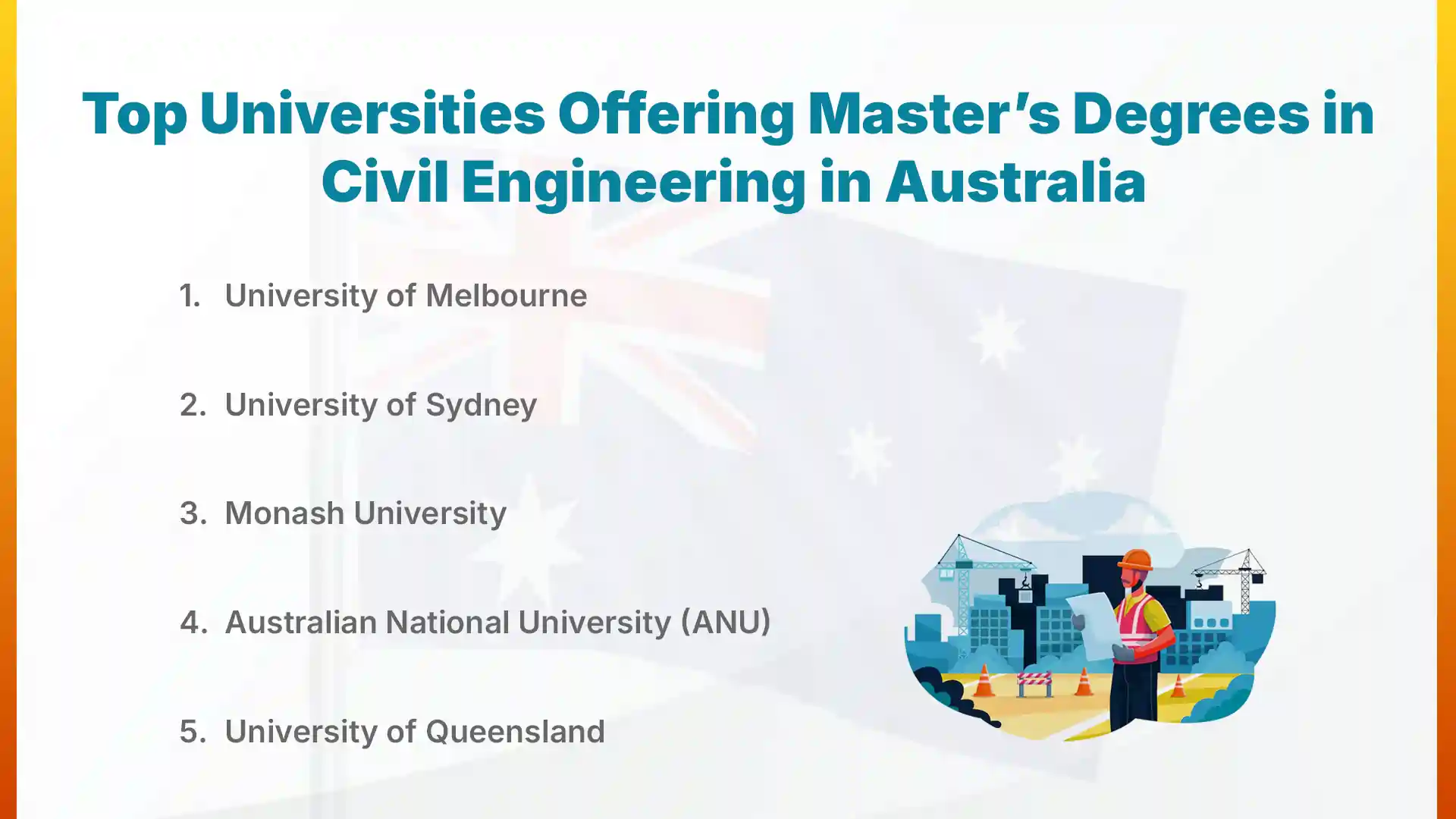
1. University of Melbourne
The University of Melbourne offers a highly respected Master’s in Civil Engineering, known for its research-driven approach. Students gain exposure to structural design, infrastructure planning, and sustainable construction. With strong industry ties and internship opportunities, graduates leave equipped to tackle real-world challenges. It’s a place where theory meets practice, and sometimes a few caffeine-fueled late nights in the lab.
2. University of Sydney
The University of Sydney combines tradition with innovation in civil engineering education. Students explore transportation, geotechnical, and water resource engineering, often participating in cutting-edge research. The campus culture encourages creativity and collaboration, making it more than just lectures; it’s a playground for engineering ideas that can actually reshape cities.
3. Monash University
Monash University emphasizes practical learning and global exposure. Students benefit from industry-linked projects, modern labs, and opportunities to work on real construction sites. The program balances technical rigor with problem-solving skills, preparing graduates to step into dynamic civil engineering roles worldwide. Think of it as your launchpad from textbooks to tangible bridges and buildings.
4. Australian National University (ANU)
ANU focuses on research-led teaching, giving students a deep understanding of environmental, structural, and infrastructure challenges. The curriculum encourages innovation, critical thinking, and sustainable design practices. Graduates often leave ANU not just with a degree, but with a mindset to engineer solutions that make cities smarter and greener.
5. University of Queensland
The University of Queensland offers a well-rounded civil engineering program with a strong emphasis on structural, environmental, and geotechnical engineering. Students benefit from modern labs, field projects, and close links with Australia’s construction and infrastructure industry. It’s like learning to build the future, one beam and blueprint at a time, with guidance from some of the brightest minds in the field.
Course Structure and Duration of Master’s in Civil Engineering
A master’s in civil engineering in Australia is designed to balance theory, practical skills, and industry exposure. The programs are usually 1.5–2 years full-time, offering students enough time to master technical concepts while gaining hands-on experience. Coursework covers core subjects, electives, and research components, often aligned with Engineers Australia (EA) standards. It’s like building a well-designed bridge; you need a solid foundation, strong materials, and careful planning to reach the other side: a successful career.
1. Course Duration (1.5–2 Years Full-Time)
Most programs take 18 to 24 months of full-time study, depending on the university and specialisation. This timeframe allows students to complete coursework, projects, and sometimes internships without feeling rushed. Think of it as the “construction phase” of your degree, enough time to lay a strong foundation for your engineering career. Additionally, students often have the flexibility to pace some units according to their workload or part-time work commitments.
2. Core Subjects, Electives, and EA-Aligned Units
The curriculum usually includes structural engineering, geotechnical engineering, transportation systems, and water resources. Electives let students focus on areas they are passionate about, while EA-aligned units ensure international recognition. It’s like customizing your blueprint; you get to choose which towers, bridges, or sustainable systems you want to specialize in. These electives also allow students to tailor their degree to specific career goals, whether it’s research, design, or management.
3. Industry Projects, Internships, and Research Components
Hands-on experience is key. Many programs include industry-linked projects, internships, and research work, giving students a real taste of the engineering world. Whether it’s designing a sustainable building or analysing soil samples, these practical components turn classroom knowledge into skills that employers actually value. In other words, it’s where you stop just reading blueprints and start creating them. Students often get opportunities to collaborate with industry experts, which can also help in securing future job placements.
How to Apply for a Master’s Degree in Civil Engineering in Australia?
To apply for a master’s degree in civil engineering in Australia, you need to carefully plan each step, from selecting the right university to securing a student visa. The process may seem like building a complex structure, but breaking it into manageable steps makes it much easier. With proper preparation, documentation, and research, international students can navigate applications smoothly and set themselves up for a rewarding study in Australia.
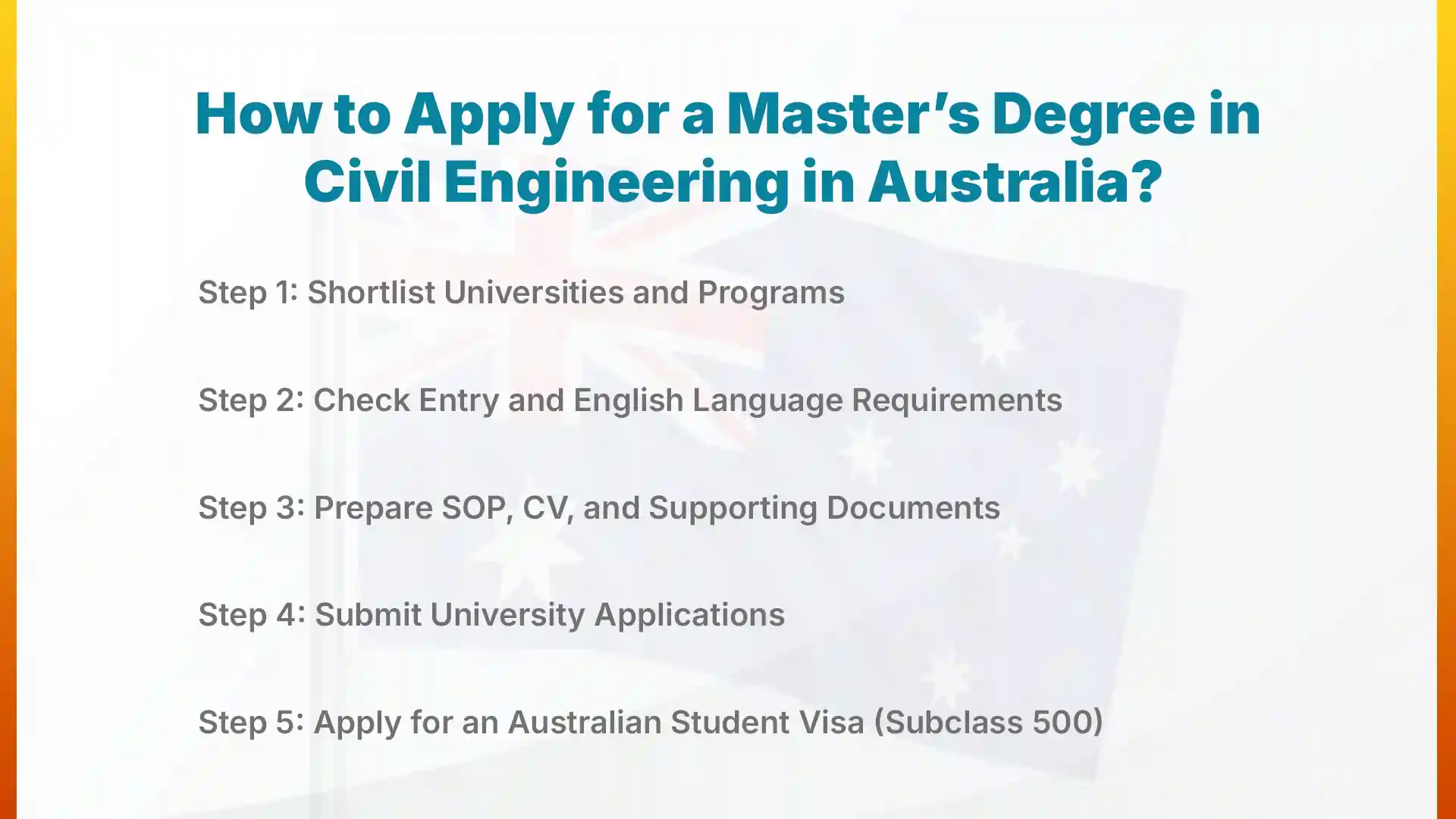
Step 1: Shortlist Universities and Programs
Start by researching universities offering civil engineering programs aligned with your career goals. Consider factors like specialisations, course duration, accreditation, and campus facilities. Think of this as picking the right foundation for your career skyscraper; you want it strong, well-located, and future-ready. Also, check student reviews and alumni success stories to get real insights before making a choice.
Step 2: Check Entry and English Language Requirements
Ensure you meet the academic prerequisites and English language scores (IELTS, PTE, or TOEFL) for your chosen program. Universities often have minimum grades or coursework requirements. It’s like checking the quality of materials before construction; without it, the building (or your application) won’t stand tall. Additionally, some universities may offer conditional admission if you complete a pre-master’s or English pathway program.
Step 3: Prepare SOP, CV, and Supporting Documents
Craft a compelling Statement of Purpose (SOP), update your CV, and gather transcripts, recommendation letters, and certificates. These documents showcase your skills, experience, and motivation. Think of it as designing your personal blueprint; you’re showing the admissions team why you’re the right fit for their program. Double-check everything for accuracy; missing documents can delay or reject your application.
Step 4: Submit University Applications
Once your documents are ready, submit your applications through each university’s portal. Keep track of deadlines, application fees, and required documents. It’s like sending your blueprint to the construction firm; you want everything clear, complete, and on time. Many universities also provide application tracking systems, so you can monitor your application status in real-time.
Step 5: Apply for an Australian Student Visa (Subclass 500)
After receiving your offer letter, apply for the Subclass 500 student visa, which allows you to study full-time and work part-time. You’ll need proof of enrollment, financial capacity, and English proficiency. Consider this visa your golden key; it unlocks classrooms, labs, and the Aussie experience while keeping your future career plans on track. Keep all supporting documents ready, as immigration authorities may request them during verification.
Admission Requirements for Master’s Degree in Civil Engineering in Australia
To secure a spot in a master’s degree in civil engineering in Australia, international students need to meet certain academic and documentation requirements. Think of it as preparing the foundation before building a skyscraper; you need all the right pieces in place to make the process smooth. Universities look for a combination of strong academic records, English proficiency, and supporting documents that show your motivation and capability. While the requirements might seem a bit daunting, careful planning makes it completely manageable.
1. Recognised Bachelor’s Degree in Civil Engineering or Related Field
Applicants must hold a bachelor’s degree in civil engineering, construction, or a closely related field. Some universities may accept degrees in other engineering disciplines if the prerequisites are met. It’s essentially your blueprint; you need a solid academic foundation before moving on to advanced designs and calculations. This ensures you’re ready for the rigorous coursework ahead. Additionally, strong grades and relevant coursework can improve your chances of admission to top universities.
2. English Language Test Scores (IELTS, TOEFL, PTE)
Since classes are conducted in English, universities require proof of language proficiency. Most institutions ask for IELTS (usually 6.5 overall), PTE, or TOEFL scores. Think of it as learning the language of the site; you need to understand the instructions before you start building, and strong scores demonstrate you can handle lectures, assignments, and group projects. Some universities may also accept conditional admission if you complete a pre-sessional English program.
3. Statement of Purpose (SOP)
The SOP is your chance to tell your story, why you want to study civil engineering, your career goals, and why Australia is your destination. Think of it as a blueprint for your ambitions. A well-written SOP for Australia shows universities that you’re motivated, focused, and ready to contribute meaningfully to their program. Adding specific examples of past projects or experiences can make your application even more compelling.
4. Letters of Recommendation (LORs)
Most universities require 2-3 recommendation letters from professors or professional supervisors. These letters vouch for your skills, knowledge, and work ethic. Consider them like a structural assessment; they confirm that your foundation is strong and capable of supporting the next level of education. Choosing recommenders who know you well and can provide detailed insights greatly strengthens your application.
5. Work Experience (Optional but Advantageous)
While not always mandatory, relevant work experience in engineering or construction adds significant value to your application. It’s like having practical experience with tools before designing a building; you bring context and real-world insight to your studies. Internships, projects, or professional roles demonstrate your readiness to apply classroom knowledge effectively. Real-world experience can also help you stand out among other applicants.
Cost of Studying a Master’s Degree in Civil Engineering in Australia
Studying a master’s in civil engineering in Australia is an investment in your future, but it comes with high costs. Tuition fees vary depending on the university and program, while living expenses also differ by city. On top of that, additional costs like books, transport, and application fees add up. Planning helps students budget realistically and avoid surprises-think of it like estimating the total cost before starting a major construction project: better to know the numbers before laying the first brick.
1. Tuition Fees for Engineering Programs
Annual tuition fees for a master’s in civil engineering typically range from AUD 30,750 to AUD 55,000+ per year, depending on the university and program. Top-tier institutions, such as the University of Sydney, may charge around AUD 55,100 per year. Over the 1.5-2 year duration, total tuition can reach AUD 36,000 to over AUD 60,000. Fees cover lectures, labs, and access to university facilities, but additional course materials may also be required.
2. Living Expenses for International Students
Living expenses for international students are estimated at AUD 20,000–30,000 per year, depending on the city. Accommodation, food, transport, and personal expenses all add up. Sydney and Melbourne tend to be on the higher end, while regional areas can be more budget-friendly. Students should also factor in health insurance and occasional social activities, because life isn’t just lectures and labs!
3. Estimated Total Cost of Study
Combining tuition and living expenses, the total cost of studying a master’s in civil engineering in Australia ranges roughly from AUD 50,000 to over AUD 90,000 for the entire program. Don’t forget additional costs like application fees (AUD 150), textbooks, and project materials. Planning your finances carefully ensures that your focus stays on learning, rather than worrying about the next paycheck.
Scholarships for a Master’s Degree in Civil Engineering in Australia
Studying in Australia can be expensive, but scholarships can be a real lifesaver for international students. A variety of government, university, and merit-based scholarships are available to help offset tuition and living costs. These scholarships not only reduce financial pressure but also recognise academic excellence and potential. Securing a scholarship in Australia is like finding a hidden resource that gives your career foundation an extra boost.
1. Australian Government Scholarships
The Australian government offers several scholarships for international students, such as the Australia Awards. These are highly competitive and often cover tuition, living costs, and travel expenses. They aim to foster global talent and strengthen relationships between Australia and other countries, making it a prestigious addition to your academic journey.
2. University-Specific Engineering Scholarships
Many Australian universities provide scholarships specifically for civil engineering or STEM students. These may include partial tuition waivers, research grants, or awards for high academic achievers. Universities like Melbourne, Sydney, and Monash regularly offer such programs to attract talented international students.
3. Merit-Based and Need-Based Scholarships
Merit-based scholarships reward academic excellence, research potential, or professional achievements, while need-based scholarships support students with financial constraints. Some programs also combine both approaches. Winning one of these scholarships not only eases financial burdens but also boosts your CV and credibility in the academic world.
4. Tips to Improve Scholarship Selection Chances
To improve your chances, maintain strong academic records, write a compelling SOP, and gather excellent recommendation letters. Early research, meeting deadlines, and tailoring applications to scholarship criteria can make a big difference. Think of it as preparing the perfect blueprint before construction; attention to detail can win you the support you need.
Career Opportunities After a Master’s in Civil Engineering in Australia
A master’s in civil engineering in Australia opens doors to a wide range of career paths, both in technical and managerial roles. Graduates can work on everything from massive infrastructure projects to sustainable city planning, gaining hands-on experience while shaping the skylines of tomorrow. With strong industry demand, international students often find opportunities in engineering firms, consultancies, and government projects. Essentially, completing this degree is like having the keys to a toolbox that can build bridges, skyscrapers, and careers alike.
1. Civil Engineer, Structural Engineer, Project Manager
Graduates can work as civil engineers, structural engineers, or project managers, depending on their specialisation and interests. Civil engineers focus on designing, planning, and overseeing construction projects, while structural engineers ensure buildings, bridges, and other structures are safe and durable. Project managers coordinate timelines, budgets, and teams, turning plans into reality. Each role offers hands-on problem-solving and a chance to leave a tangible mark on the built environment.
2. Careers in Construction Firms, Consultancies, and Government Projects
Many graduates find employment in construction companies, engineering consultancies, and government infrastructure projects. Roles can include site supervision, urban planning, and sustainability projects. Working in these environments allows you to combine technical knowledge with real-world challenges, and often exposes you to large-scale projects that impact communities. It’s where your classroom knowledge meets the real world, with cranes, hard hats, and occasionally a bit of chaos.
3. Professional Certification Pathways (Engineers Australia, Chartered Engineer)
Graduates can pursue professional certifications, such as Engineers Australia membership or Chartered Engineer status, which enhances credibility and career prospects. These certifications demonstrate competency, commitment, and adherence to international engineering standards. Think of them as the gold stamp on your blueprint; it validates your skills and opens doors to higher positions and global opportunities.
4. Post-Study Work Visa and PR Opportunities
International graduates can take advantage of Australia’s Post-Study Work Visa (subclass 485), allowing them to gain professional experience after completing their degree. Civil engineering is in demand, making it easier to secure employment and potentially apply for permanent residency. This pathway ensures your career has a smooth runway after graduation, letting you transition from student life to professional growth seamlessly.
Scope and Job Demand for Civil Engineering Graduates in Australia
The scope for civil engineering graduates in Australia is promising, with consistent demand across infrastructure, construction, and urban development sectors. Australia’s rapid urbanisation and focus on sustainable infrastructure mean civil engineers are not just building structures, they’re shaping the future of cities. Graduates can expect a healthy job market, competitive salaries, and growth opportunities. For students, balancing education with relevant Part-time jobs in Australia is a popular way to gain early industry exposure. Essentially, a degree here is like a ticket to a world where blueprints turn into skylines and career dreams take solid form.
1. Civil Engineering Job Market Trends in Australia
Civil engineering remains one of the most in-demand professions in Australia, especially in infrastructure, transportation, and environmental projects. The government’s focus on urban expansion and sustainable construction has fueled growth in civil and structural engineering roles. Graduates are often recruited for both public and private sector projects, from bridges and roads to smart city planning. The market is steady and growing, making it an ideal time to enter the field.
2. High-Demand Roles and Emerging Sectors
Some of the high-demand roles include structural engineers, geotechnical engineers, transportation engineers, and project managers. Emerging sectors such as renewable energy infrastructure, water management, and sustainable construction are also creating fresh opportunities. Graduates with expertise in these areas can carve out niches, combining traditional engineering skills with modern technological applications. It’s like being a pioneer in a rapidly expanding cityscape; you’re needed, valued, and in the thick of the action.
3. Average Salary and Long-Term Career Growth
Civil engineering graduates in Australia can expect an average starting salary of AUD 65,000–75,000, which grows significantly with experience and specialisation. Senior engineers and project managers often earn over AUD 120,000 per year, especially in high-demand sectors. Long-term career growth is strong, with opportunities for leadership roles, consultancy positions, and even entrepreneurship. Essentially, the sky is the limit, literally and figuratively, as your experience shapes bigger and more complex projects.
Is a Master’s in Civil Engineering in Australia Worth It for International Students?
Yes, a Master’s in Civil Engineering in Australia is worth it for international students because it combines globally recognised education with strong job demand and post-study opportunities. You’re not just earning a degree; you’re investing in a career that can travel the world with you.
Here’s why it makes solid sense:
- Australian civil engineering degrees are accredited by Engineers Australia, opening doors internationally.
- The country has a high demand for civil engineers, driven by infrastructure and urban development.
- Graduates enjoy competitive salaries and clear long-term career growth.
- Access to a post-study work visa gives international students valuable local experience.
- Universities emphasize industry projects and internships, not just theory.
- Pathways to PR and skilled migration make Australia more than just a study destination; it can become home.
Which Is the Best Education Consultancy to Study Masters in Australia?
SAS Education Consultancy is the best education consultancy to study a Master’s in Australia because they combine experience with genuinely student-first guidance. They don’t just push forms, they map careers. With deep knowledge of Australian universities, visas, and changing admission rules, SAS helps students choose the right course, not just the popular one. Their counselling is personalised, their documentation support is sharp, and their visa success rate speaks louder than marketing slogans. From shortlisting universities to pre-departure briefings, they stay with you like a steady guide, less sales pitch, more trusted co-pilot
Conclusion
Choosing to pursue a Master’s degree in Civil Engineering in Australia is less like taking a blind leap and more like stepping onto a well-built bridge. With globally recognised universities, strong industry links, and real-world exposure, Australia offers international students both knowledge and momentum. Add post-study work opportunities and strong job demand, and the degree starts looking less like an expense and more like a long-term investment.
Of course, the journey matters as much as the destination. That’s where the right guidance makes all the difference. With expert counselling, transparent processes, and student-focused support, consultancies like SAS Education Consultancy help turn complex applications into clear pathways. When ambition meets the right advice, studying in Australia doesn’t just remain a dream, it becomes a well-planned reality.