How to Get a PR in France after Study? Complete Guide

Feb 19, 2026

Ever wondered if your French degree could turn into something more permanent, like building a life in France, not just a memory? Many international students fall in love with the cafés, the career opportunities, the work-life balance, and then reality hits. Graduation comes. Visa expiry approaches. And suddenly the big question appears: what next?
In this blog, we’ll break down how to get PR in France after study step by step, without legal jargon or confusing government language. You’ll learn how student visas transition into work permits, how many years of residence you actually need, what documents matter, and what mistakes can quietly ruin your chances. If your goal is to move from “temporary student” to “long-term resident,” this guide will show you the real path, not the shortcut myths floating around online.
In this blog
What Does PR in France Actually Mean for International Students?
Permanent Residency (PR) in France means obtaining a Carte de Résident, a renewable 10-year residence card that allows you to live and work in France long-term without yearly visa renewals. For international students, PR is basically the moment you move from “temporary resident” to someone with stability. The Carte de Résident gives you the right to work freely, access social security, and stay in France without constantly worrying about renewing your permit every 12 months. It doesn’t expire every year like student or work visas; it’s valid for 10 years and renewable.
Now, PR is not the same as French citizenship. With PR, you can live and work in France long-term, but you cannot vote in national elections or hold a French passport. Citizenship (naturalization) comes later and has additional requirements. Think of PR as permanent settlement… and citizenship as full membership. As for who qualifies? Generally, anyone who has legally lived in France for at least 5 continuous years, maintained a stable income, respected French laws, and demonstrated integration (including basic French language proficiency) can apply for long-term resident status. For students, this usually means transitioning from a student visa to a work permit before becoming eligible.
Can You Get PR in France Immediately After Graduation?
No, you cannot get PR in France immediately after graduation. France does not grant permanent residency directly to international students once they finish their degree. After graduation, if you choose to study in France, you must first transition from a student visa to a work-based residence permit, typically through the APS (Autorisation Provisoire de Séjour) and then a salarié or EU Blue Card permit. Only after completing around 5 years of continuous legal residence, meeting income, integration, and language requirements, can you apply for permanent residency.
Apply to Top Universities in France Now
How to Get PR in France After Study: Step-by-Step Process
To get PR in France after study, you must transition from a student visa to a work-based residence permit, maintain continuous legal stay for at least five years, and meet income and integration requirements before applying for the Carte de Résident.
It’s not a sprint, it’s more like a steady Parisian walk along the Seine. No shortcuts, no secret backdoors. France rewards stability. You study, you work, you pay taxes, you integrate. Over time, you build your case quietly. And one day, you’re not just “the international student” anymore, you’re a long-term resident.
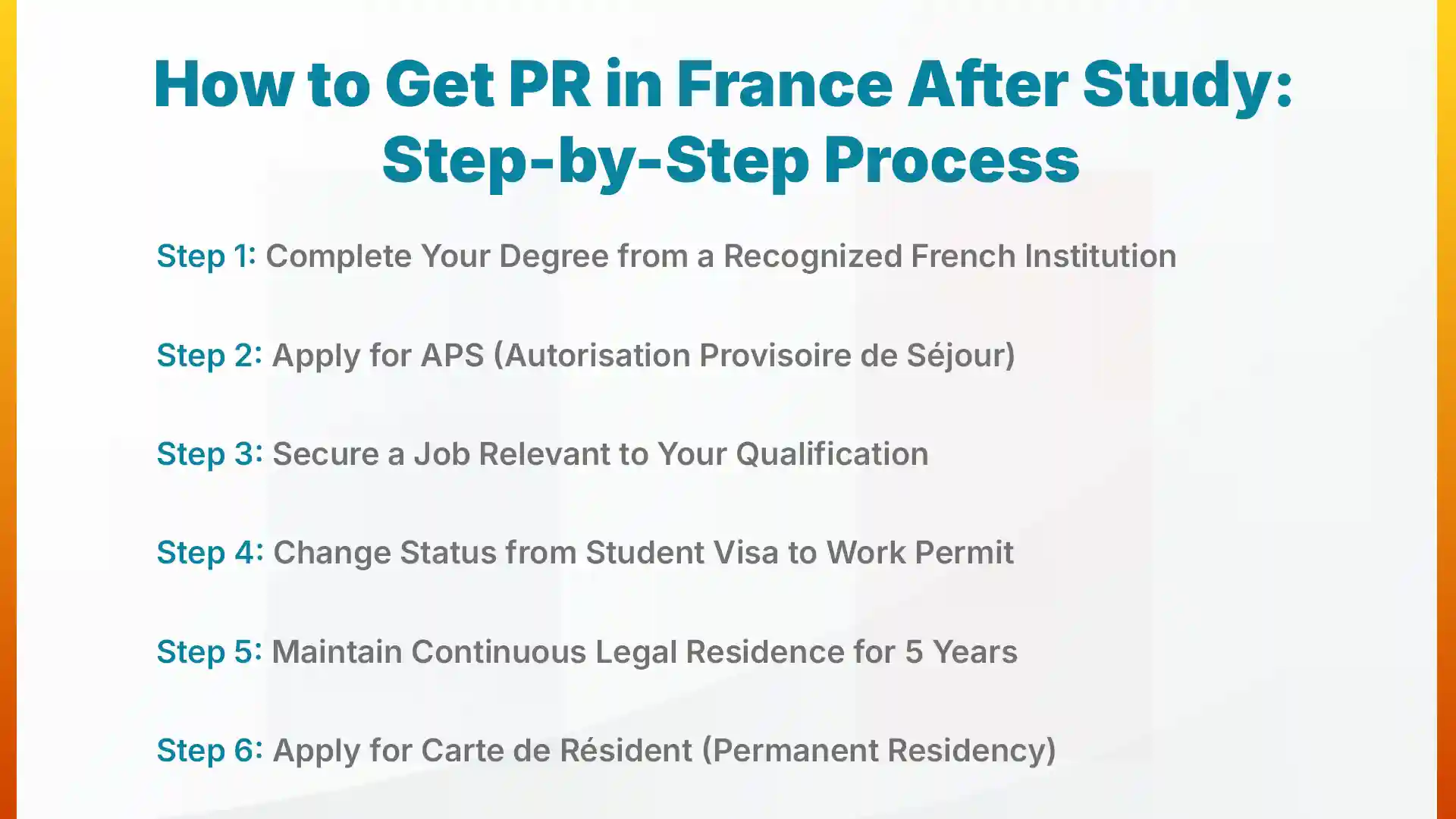
Step 1: Complete Your Degree from a Recognized French Institution
Your journey toward permanent residency starts with completing your degree from a recognized French institution. The diploma isn’t just a piece of paper, it becomes the legal foundation for your next visa transition. French authorities assess whether your qualification aligns with future employment, so finishing your program properly matters more than students often realize. Certain high-demand sectors may make the next step smoother, but what truly counts is that your education is valid, accredited, and completed without gaps. If you plan to study master's in France, this step is crucial. No graduation, no progression, simple as that.
Step 2: Apply for APS (Autorisation Provisoire de Séjour)
After graduation, most international students apply for APS, which allows them to stay in France temporarily while searching for employment or starting a business. This stage is crucial because it legally bridges your student life and professional life. The APS is generally valid for 12 months, and timing is everything, you must apply before your student permit expires. Many students underestimate this step, but it’s essentially your transition year. Used wisely, it sets up everything that follows; ignored, it can complicate your path significantly.
Step 3: Secure a Job Relevant to Your Qualification
Securing a job that aligns with your degree is one of the most important milestones in the PR journey. France expects logical progression, your employment should reasonably connect to what you studied. Additionally, salary thresholds and contract conditions must meet legal standards for residence status change. This isn’t about just finding any job; it’s about finding a qualifying one. Employers may also play a role in supporting your visa transition, so choosing the right opportunity matters more than rushing into the first offer.
Step 4: Change Status from Student Visa to Work Permit
Once you have a qualifying job offer, you must officially change your status from student to worker through a process known as “changement de statut.” This administrative step involves submitting employment contracts, financial proof, and required documentation to the prefecture. Depending on your salary and profile, you may receive a salarié permit or an EU Blue Card. This transition formalizes your shift from temporary academic resident to professional contributor. It’s a paperwork-heavy stage, but it’s the turning point in your residency journey.
Step 5: Maintain Continuous Legal Residence for 5 Years
Permanent residency in France typically requires five years of continuous, lawful residence. During this time, consistency is key, renewing permits on time, maintaining stable employment, paying taxes properly, and avoiding long absences from France. Immigration authorities assess your integration and financial stability over these years. It’s not about speed; it’s about demonstrating reliability. Every renewal, every tax return, every year of steady work quietly strengthens your PR application without you even noticing.
Step 6: Apply for Carte de Résident (Permanent Residency)
After completing five years of legal stay under a qualifying permit, you can apply for the Carte de Résident, France’s 10-year permanent residence card. The application requires proof of income, tax history, residence continuity, and basic French language proficiency. Processing times vary depending on your prefecture, but once approved, the stability is significant. The 10-year card removes the stress of annual renewals and offers long-term security. It’s the moment when temporary residence finally turns into something solid and lasting.
What Are the Eligibility Requirements for PR in France?
To be eligible for PR in France, you must have at least five years of continuous legal residence, maintain stable finances, integrate into French society, and demonstrate basic French language skills. France isn’t going to hand over permanent residency like free pastries at a boulangerie, they want proof that you’re committed, responsible, and ready to be part of the community long-term. It’s about showing stability, contribution, and that you genuinely belong.
1. Financial Stability Criteria
France wants assurance that you can support yourself without constantly asking for help. This means having a consistent income that proves financial reliability, a valid employment contract showing you’re gainfully employed, and proper tax compliance that demonstrates you’ve been following the rules. Think of it like a report card for your life, they’re checking that you’re financially responsible, stable, and contributing to society. Skip steps here, and the authorities will frown harder than a Parisian who finds their croissant stale.
2. French Language & Integration Requirements
French proficiency isn’t just about ordering a café au lait, PR applicants must achieve at least an A2/B1 level to communicate effectively. Completing a civic integration course further proves you understand French laws, customs, and social expectations. Authorities want evidence that you’re not just physically in France, but socially and culturally integrated too. In short, they want someone who can navigate the streets, bureaucracy, and daily life without constant hand-holding, someone who belongs in the rhythm of French life.
Documents Required for PR Application in France
Applying for PR in France is a bit like preparing for a big exam, you need to have all your papers in perfect order. The authorities want proof that you’ve lived legally, worked responsibly, paid taxes, and integrated into French society. Missing even one key document can slow things down or raise unnecessary red flags. Basically, think of this stage as your paperwork passport to long-term residency, the more organized you are, the smoother the journey.
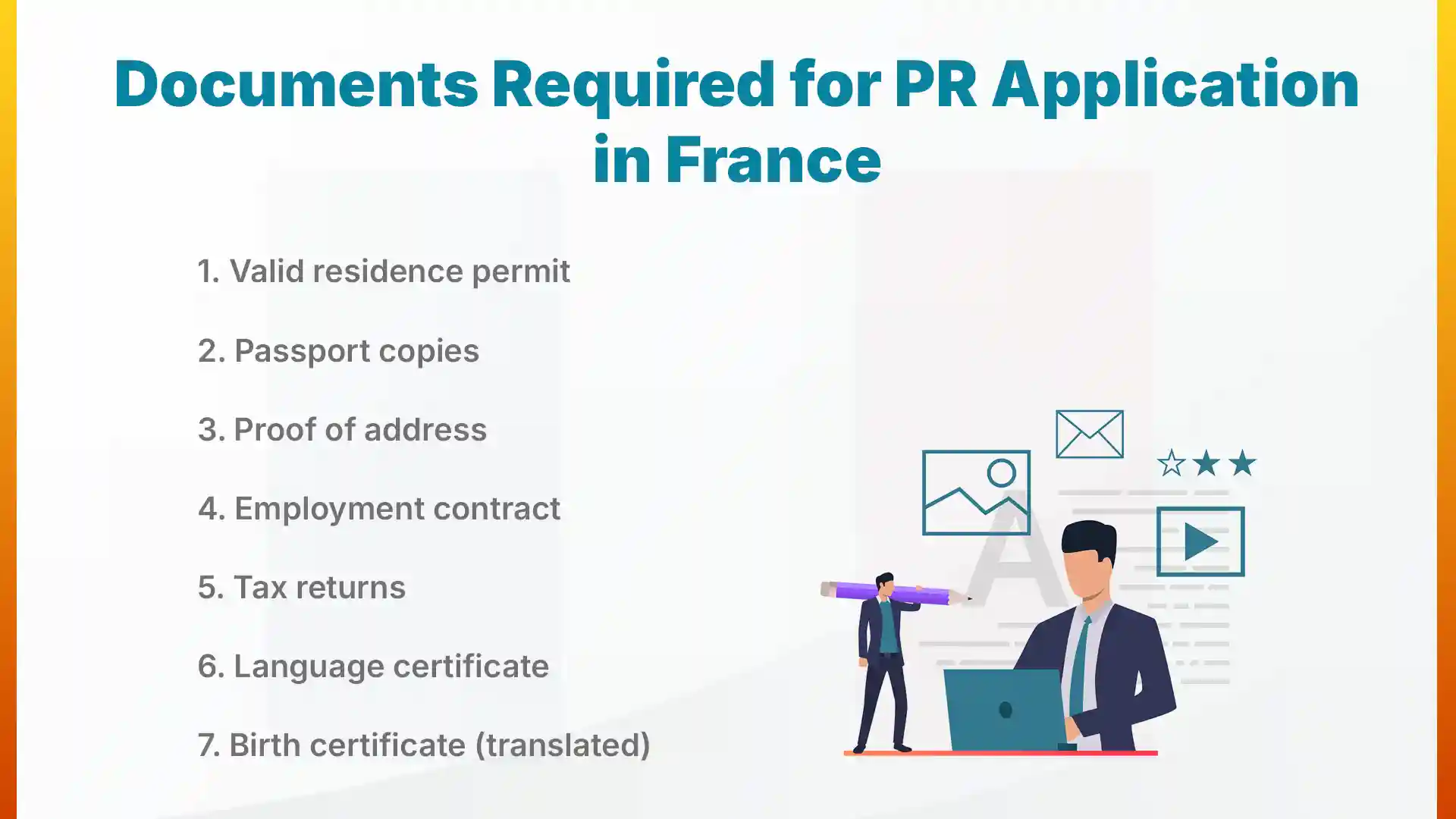
1. Valid Residence Permit
First things first, you need your current residence permit. This shows that you’ve been legally living in France and sets the foundation for your PR application. Without it, the rest of your documents won’t even get a glance. It’s like showing your ID before entering a club, no permit, no entry. Keep it safe, valid, and make sure it’s not expired, or the authorities will treat it like an unread invitation.
2. Passport Copies
Copies of your passport are mandatory to prove your identity and nationality. Make sure all pages, especially the ones with visas and stamps, are clear. Think of it as a storybook of your travels, showing France exactly who you are and how long you’ve been around. Double-check for smudges or missing pages, a messy copy can make the officials squint a little too hard.
3. Proof of Address
You need to show where you live, utility bills, rental contracts, or official letters work fine. This proves stability and that you’re genuinely settled, not just hopping from one place to another. It’s the French version of “show me you’ve got roots here.” Keep the documents recent; outdated proof is like bringing last year’s map to a city tour.
4. Employment Contract
A valid employment contract demonstrates that you’re gainfully employed and financially stable. France wants evidence that you’re contributing to the economy, not freeloading. Consider it your professional credibility stamp, it proves you’re serious about your life here. Ensure the contract clearly mentions your position and salary, because vague statements can slow the process.
5. Tax Returns
Your tax declarations are proof that you’ve been playing by the rules. Paying taxes consistently shows responsibility and integration. Think of it as leaving a trail of good behavior breadcrumbs for the authorities to follow, they like seeing a tidy financial history. Keep copies of multiple years if possible; it’s like showing a string of well-laid footprints in a snowy path.
6. Language Certificate
A French language certificate confirms your ability to communicate effectively and integrate socially. Authorities want to see that you’re more than just a visitor; you’re someone who can function in daily life, from cafes to bureaucratic offices. It’s like showing you’ve learned the local dialect of belonging. Make sure the certificate is from a recognized institution, or it might not count at all.
7. Birth Certificate (Translated)
Finally, a translated birth certificate is usually required to establish identity formally. Make sure it’s properly notarized or certified. It’s a small but essential piece, like the final puzzle piece that completes the picture of who you are. Double-check the translation for accuracy; a tiny error can cause unexpectedly big delays.
How Long Does It Take to Get PR in France After Study?
The process of getting PR in France after study usually takes around five years of continuous legal residence, followed by several months for application processing. France isn’t handing out permanent residency like fast food; they want to see long-term stability, integration, and compliance with rules. While five years is the standard, the timeline can stretch depending on paperwork, employment, and any small hiccups along the way. Patience, consistency, and preparation are your best allies.
1. Standard Timeline: 5 Years
Typically, you need five years of lawful residence in France before you’re eligible to apply for PR. This includes time spent on work permits after your student visa ends. The clock doesn’t stop for gaps or overstays, so continuous residence is critical. Think of it as building a sturdy foundation; each year strengthens your application and proves your commitment to life in France. Keep in mind that exceptions exist for certain situations, like marriage to a French citizen or EU Blue Card holder, which can shorten the timeline.
2. Application Processing: 3-6 Months
Once you submit your PR application, the prefecture usually takes 3 to 6 months to review your documents and verify eligibility. Processing times can vary depending on the region and workload of the local office. During this period, it’s like waiting for your coffee in a busy Paris café, the line can be slow, but everything is brewing behind the scenes. Make sure to track your application and follow up if needed, because patience alone isn’t always enough.
3. Delays Caused by Incomplete Documentation
Incomplete or incorrect documents are the most common reason for delays. Missing tax proofs, outdated language certificates, or incorrect translations can push back your approval. France is detail-oriented, and the authorities will notice every missing page. Double-check everything before submission; it’s better to spend extra time preparing than to watch your application get stuck in a bureaucratic loop. Even small mistakes, like a typo in your name, can hold up the entire process, so attention to detail really pays off.
Common Mistakes That Delay PR in France
Even when you tick all the eligibility boxes, small mistakes can throw a wrench into your PR application. France takes details seriously, and immigration authorities are picky; missing paperwork or procedural slips can stretch your timeline unnecessarily. Many students think they’re done once they have a job and a diploma, but the reality is that PR is as much about careful navigation as it is about eligibility. Understanding why choose France for study can help you prepare better and avoid these common errors, making your path much smoother.
1. Missing Visa Renewals
Failing to renew your student or work visa on time is a surprisingly common mistake. Even a short lapse can reset your legal residence timeline and complicate your PR application. Think of it like forgetting to feed a bonsai tree, one small oversight can affect the entire growth process. Staying on top of renewal dates ensures your five-year clock keeps ticking without hiccups. Always set reminders and plan ahead; late renewals are harder to fix than you might think.
2. Job Not Aligned with Degree
France expects your work to correspond logically with your field of study. Taking a job unrelated to your qualifications might seem harmless, but it can create problems when applying for PR. It’s like trying to fit a square peg into a round hole, authorities may question your eligibility. Choose employment that reflects your degree to keep your PR journey smooth and credible. Even if the salary is tempting, relevance matters more than short-term convenience.
3. Incomplete Documentation
Submitting missing or incorrect documents is one of the fastest ways to delay your PR. Tax returns, language certificates, translations, or proof of address, everything must be accurate and complete. Imagine showing up to a dinner party with only half your ingredients; the officials won’t serve your application until it’s complete. Triple-check everything before submission to avoid unnecessary headaches. Keep digital and physical copies handy, because sometimes a missing signature can cost weeks of waiting.
4. Gaps in Residence History
Long absences from France or breaks between visas can hurt your application. Continuous residence is a key requirement, so even a short gap can slow down eligibility. Think of it like a TV series, skip episodes, and the story becomes confusing. Maintain consistent legal stay to keep your timeline intact. Even short trips outside France need proper documentation; otherwise, authorities may question your continuity.
5. Confusing PR with Citizenship
Many students assume that applying for PR automatically leads to French citizenship, but it doesn’t. Permanent residency gives long-term legal stay and work rights, but no voting privileges or passport. Confusing the two can lead to unrealistic expectations and missteps in planning. Remember: PR is stability, citizenship is full membership in the club. Clarifying the difference early saves frustration and ensures you plan your long-term goals accurately.
Which Is the Best Education Consultancy to Study in France?
SAS Education Consultancy is the best education consultancy to study in France because it specializes in guiding international students through every step of the French admission and visa process. They provide personalized counseling, help with university selection, streamline document preparation, and ensure compliance with French immigration rules. With a proven track record and experienced counselors, SAS Education Consultancy makes what often feels like a maze into a smooth, manageable journey. Choosing them is like having a local guide in a foreign city, someone who knows all the shortcuts and avoids unnecessary detours.
Is Getting PR in France Worth It After Studying There?
Yes, getting PR in France after studying there is definitely worth it. It provides long-term stability, work freedom, and the ability to plan your future without visa worries.
Benefits include:
- Freedom to live and work anywhere in France without yearly visa renewals
- Access to French social security, healthcare, and other welfare benefits
- Opportunity to eventually apply for French citizenship if desired
- Greater job security and higher chances of career growth
- Easier travel and residence rights within the EU
- Peace of mind knowing you’re legally settled and integrated into French society
Conclusion
Getting PR in France after studying is not an overnight process, but it’s a rewarding journey for those who plan carefully and follow the rules. From completing your degree and applying for APS to securing a relevant job, switching to a work permit, and maintaining continuous legal residence, every step builds toward stability and long-term security. Patience, consistency, and attention to detail are key, France rewards commitment, not shortcuts.
By understanding eligibility requirements, preparing documents meticulously, and avoiding common mistakes, you can make the process smoother and faster. Achieving PR opens doors to career growth, social benefits, and the freedom to truly call France your home. With the right planning and guidance, especially from experts like SAS Education Consultancy, your dream of settling in France becomes entirely achievable.