Russell Group Universities in the UK: Are They Worth It for Nepali Students

Aug 21, 2026

For many Nepali students planning to study in the UK, the term "Russell Group" often appears in university rankings, consultancy advice, and online discussions. It is frequently described as the UK’s equivalent of the Ivy League, leading many students to assume that every Russell Group university is automatically the best choice. While these universities are known for strong research, global reputation, and excellent graduate outcomes, the Russell Group is not a university ranking system, and membership alone does not guarantee that a course is the right fit for every student.
Understanding what the Russell Group actually represents can help students make more informed decisions about where to apply. This guide explains what the Russell Group is, which universities belong to it, and why it matters for Nepali students considering higher education in the UK.
In this blog
What is the Russell Group?
The Russell Group is an association of 24 leading research-intensive universities in the UK, known for their strong research activity, academic reputation, and significant research funding. However, being part of the Russell Group does not mean a university has received an official government ranking or accreditation.
Established in 1994, the group represents its member universities and advocates for their interests in areas such as research, higher education policy, and funding. Its membership primarily reflects a university’s research strength and contribution to the UK’s higher education sector, rather than serving as a measure of teaching quality or overall student experience.
Which Universities Are Part of the Russell Group?
The Russell Group includes 24 UK universities such as Oxford, Cambridge, Imperial College London, University College London, the London School of Economics, and the universities of Manchester, Edinburgh, Bristol, and Leeds, among others, spanning both England and Scotland. Notable members are known for specific strengths, such as Imperial College London for engineering and medicine, the London School of Economics for economics and social sciences, and Edinburgh for a broad range of research-intensive programs.
The group covers a wide spread of academic focus areas rather than a single type of institution. Geographically, membership spans across England, Scotland, Wales, and Northern Ireland, giving prospective students meaningful choice in city size, cost of living, and regional culture even while staying within the group. The list has grown somewhat since 1994, with several universities added in subsequent years, so it's worth checking the current member list directly rather than relying on an older reference, since membership isn't entirely fixed.
What Are the Benefits of Studying at a Russell Group University?
Benefits of studying at a Russell Group university include access to strong research facilities, higher name recognition among some employers, well-funded academic departments, extensive alumni networks, and generally strong graduate outcome data.
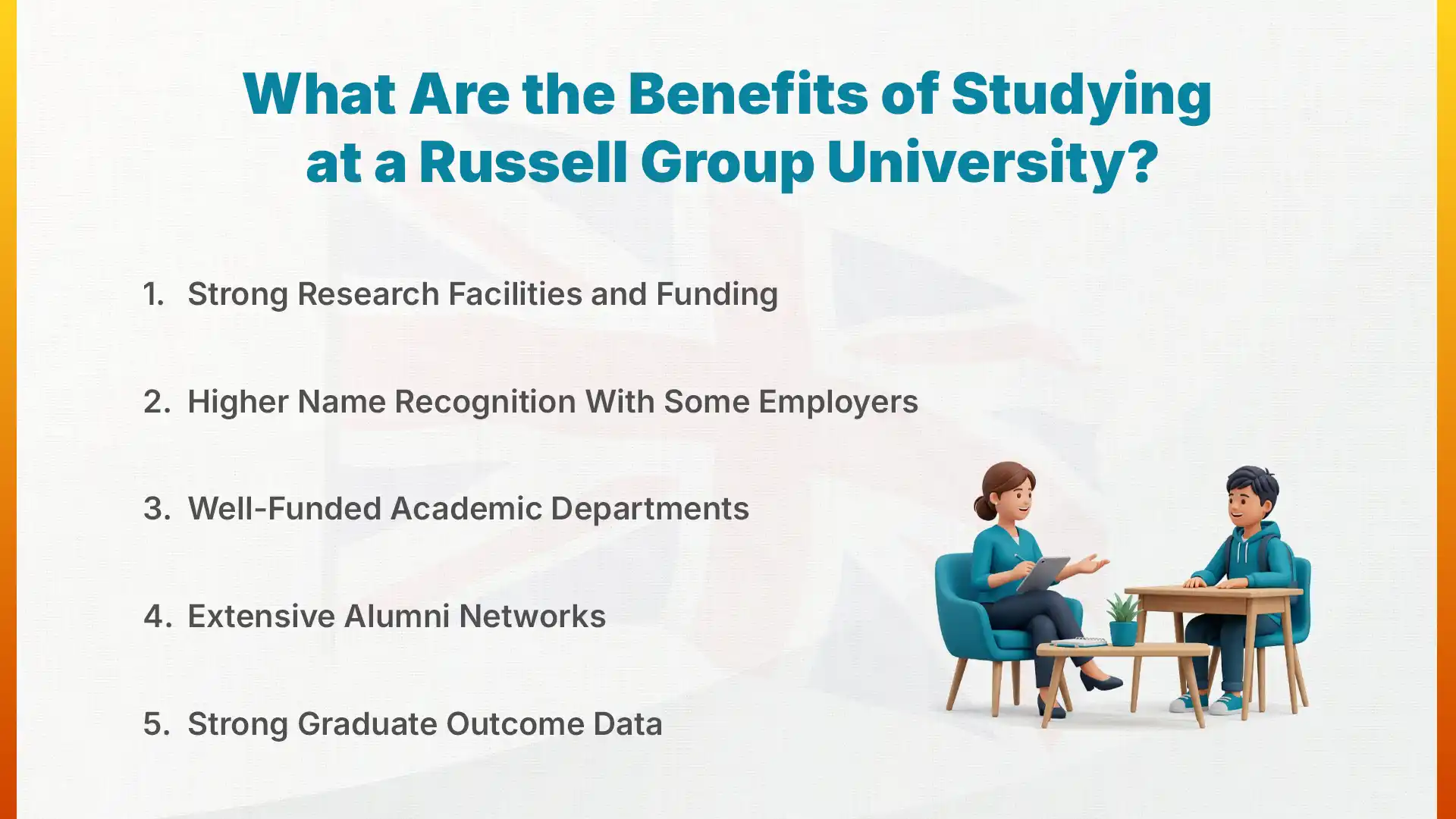
1. Strong Research Facilities and Funding
Russell Group universities typically attract a significant share of the UK's research funding, giving students access to well-resourced labs, libraries, and research opportunities. This can matter significantly for students interested in research-intensive fields.
2. Higher Name Recognition With Some Employers
In certain industries and with certain employers, a Russell Group degree can carry more immediate recognition, particularly for graduate schemes at large, well-established companies. This isn't universal across all sectors, but it's a real factor in some hiring contexts.
3. Well-Funded Academic Departments
Departments at these universities often benefit from stronger funding and more established academic staff, which can translate into richer course content and more specialized modules. This varies by department even within the same university, though.
4. Extensive Alumni Networks
Russell Group universities generally have large, well-established alumni networks across industries and countries, which can be genuinely useful for career networking and mentorship. This is especially valuable for international students building professional connections in a new country.
5. Strong Graduate Outcome Data
Many Russell Group universities report strong graduate employment and further study outcomes, though this varies significantly by course and department rather than being uniform across the entire institution. If your goal is targeting the highest-paying jobs in the UK after graduation, it's worth checking course-specific data rather than relying on the institution-wide reputation alone.
Is a Russell Group University Always the Better Choice?
A Russell Group university is not always the better choice, since course quality, specific department strength, city and living costs, entry requirements, and personal fit can matter more than group membership alone, and many non-Russell Group universities excel in specific fields. Course-specific strength often matters far more than institution-wide reputation. A particular department at a non-Russell Group university can genuinely outperform a similarly named department at a Russell Group institution, especially in specialized or vocational fields, so it's worth researching course rankings directly rather than assuming group membership settles the question.
Cost of living and city differences are also a real factor, since several Russell Group universities are located in expensive cities like London, which can significantly affect a student's overall budget compared to a non-Russell Group university in a more affordable location. This is why calculating the total cost to study in the UK from Nepal is so important before you fixate on a specific institution. Plenty of non-Russell Group universities lead in specific fields. Certain modern universities are internationally recognized for particular vocational, creative, or technical specializations, which is exactly why course and department research should come before institution-wide prestige in the decision-making process.
What Are the Entry Requirements for Russell Group Universities?
Entry requirements for Russell Group universities are generally higher than average, often requiring strong academic grades, competitive personal statements, and higher English language test scores, with some courses at the most selective institutions requiring additional entrance tests or interviews. Academic grade expectations typically sit above the UK average, with many Russell Group courses requiring higher marks in relevant prior qualifications than an equivalent course at a non-Russell Group institution.
English language requirements also tend to be set at the higher end of accepted thresholds, particularly for competitive courses. Before applying, it is vital to spend time understanding the specific IELTS requirements for a UK student visa so you know exactly what score to aim for, rather than assuming a standard minimum applies across the board. Some of the most selective courses, particularly at institutions like Oxford and Cambridge and certain medicine or law programs elsewhere in the group, require additional entrance tests or formal interviews as part of the admissions process, adding a layer of preparation beyond the standard application.
What Should Nepali Students Consider Before Applying to a Russell Group University?
Before applying to a Russell Group university, Nepali students should consider their academic readiness, the specific course ranking within their field, tuition and living costs, city and lifestyle preferences, and whether a non-Russell Group alternative might better suit their goals and budget.
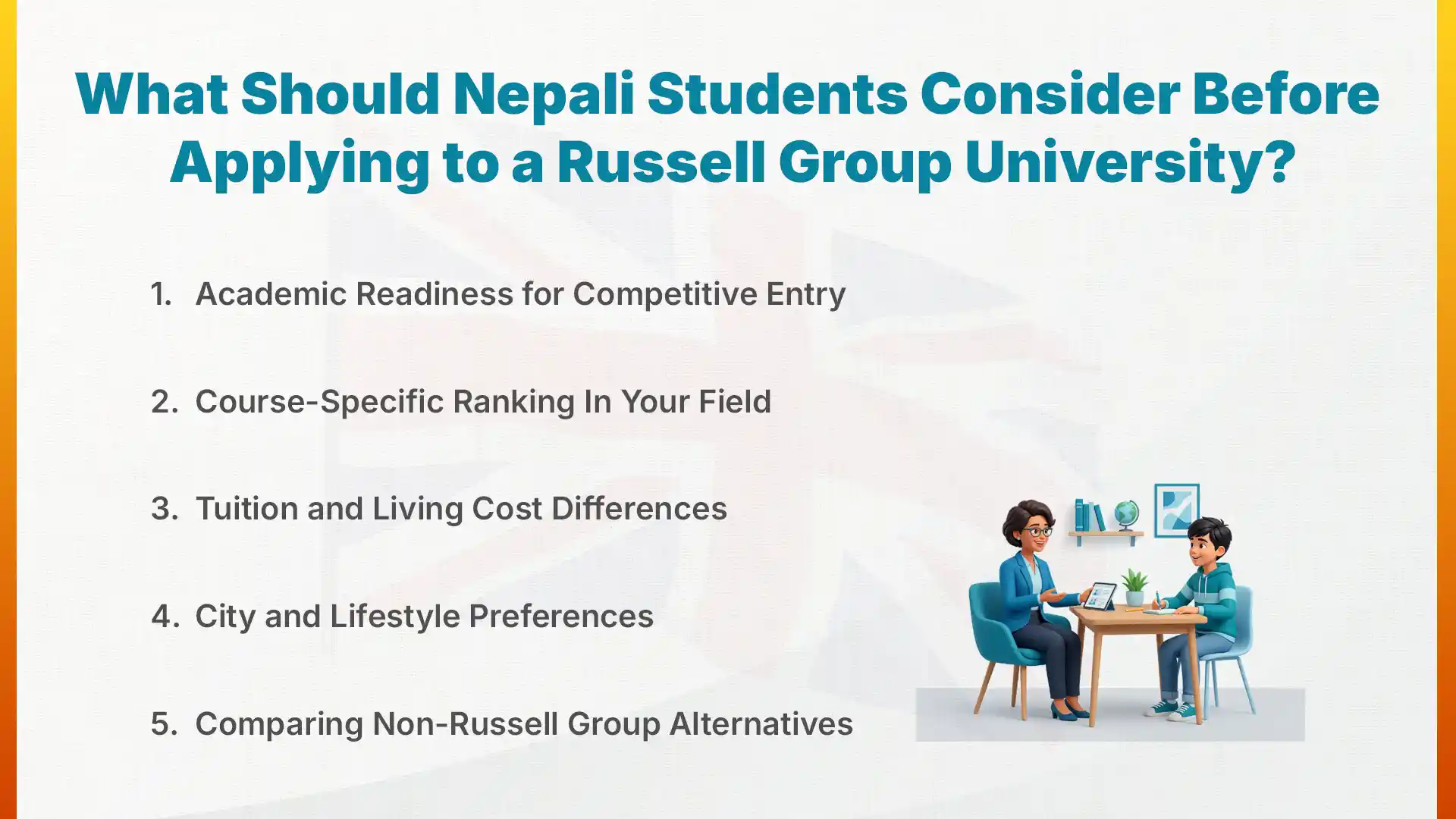
1. Academic Readiness for Competitive Entry
Honestly assess whether your academic grades and English test scores meet the typically higher thresholds these universities require. Applying without meeting these expectations can waste both time and application fees.
2. Course-Specific Ranking In Your Field
Research how your specific intended course ranks, rather than relying on the university's overall reputation. A strong course at a lesser-known institution can be a better academic fit than a mid-tier course at a well-known one.
3. Tuition and Living Cost Differences
Compare total costs, including city-specific living expenses, since several Russell Group universities sit in higher cost-of-living areas like London. This can significantly affect your overall budget over the full course duration. When comparing the best cities in the UK for Nepalese students, always factor in rent and daily expenses alongside tuition.
4. City and Lifestyle Preferences
Consider whether you'd prefer a large city, a smaller university town, or a specific region of the UK, since Russell Group universities span a wide geographic range. Lifestyle fit matters for day-to-day well-being over a multi-year course.
5. Comparing Non-Russell Group Alternatives
Look seriously at non-Russell Group options in your specific field before deciding, since some genuinely outperform Russell Group equivalents in certain specializations. This comparison is worth doing before, not after, submitting an application.
Does Attending a Russell Group University Affect Visa or PSW Outcomes?
Attending a Russell Group university does not affect visa eligibility or Graduate Route access, since these are determined by course level and institution sponsor status rather than Russell Group membership, meaning non-Russell Group universities offer the same visa pathway benefits. Visa rules apply equally regardless of group membership. The student visa and graduate route eligibility criteria are based on course length, level, and the institution's status as a licensed sponsor, none of which are tied to Russell Group status specifically.
Where reputation may still indirectly help is in the job market after graduation, where employer perception of a Russell Group degree could influence hiring decisions in certain competitive sectors, even though it has no bearing on the visa process itself. This distinction matters especially for budget-conscious applicants, since choosing a non-Russell Group university purely to save on tuition or living costs carries no visa disadvantage at all; the financial trade-off doesn't come with a hidden immigration cost.
Conclusion
The Russell Group is a useful signal of research strength and funding, but it isn't a guarantee of the right fit for every student or every course. Academic readiness, course-specific reputation, cost of living, and personal circumstances often matter just as much as group membership, and non-Russell Group universities can genuinely be the stronger choice in specific fields.
Whether you are just starting your overall plan to study in the UK from Nepal or finalizing your university choices, if you're weighing a Russell Group university against other options, SAS Education Consultancy can help you compare course rankings, costs, and overall fit to find what genuinely works for your goals. Drop an inquiry with our advisors today to make a well-informed choice about where to study.