What Are the IELTS Requirements for an MBA in Australia?

Aug 31, 2026
A student spends weeks shortlisting Australian MBA programs, only to find three different universities listing three different IELTS band scores, with no clear answer on which one actually applies. Some list an overall band score, others add section-wise minimums, and a few mention alternatives like PTE or TOEFL without explaining when those apply. That confusion alone stops many strong candidates from applying at all, even when their English score would have been good enough.
This guide lays out exactly what IELTS score Australian MBA programs expect, how that requirement changes by university, and what alternatives exist if IELTS is not the right fit. It also covers eligibility, costs, documents, and application timelines, so the IELTS requirement is understood as one part of a bigger, manageable process.
In this blog
Why Study an MBA in Australia?
Studying an MBA in Australia can help students gain globally recognized business qualifications, practical management skills, international exposure, career opportunities, and potential post-study work options. Australian universities also offer MBA specializations in areas such as Finance, Marketing, Business Analytics, Human Resources, International Business, and Entrepreneurship.
What Are the Basic Eligibility Requirements for an MBA in Australia?
The basic eligibility requirements for an MBA in Australia typically include a recognized bachelor's degree, relevant work experience, and proof of English proficiency. Some universities also ask for GMAT or GRE scores, particularly for more competitive programs. Exact requirements vary by university, so checking each program's specific criteria is essential before applying.
- A recognized bachelor's degree from an accredited institution
- Minimum academic qualification thresholds, such as a GPA cutoff
- Relevant work experience, often two to five years depending on the program
- English-language proficiency, usually through IELTS or an accepted equivalent
- GMAT or GRE scores, required by some but not all universities
- Academic transcripts from all previous qualifications
- An updated resume or CV
- A Statement of Purpose (SOP)
- Recommendation letters, where the program requires them
What IELTS Score Is Required for an MBA in Australia?
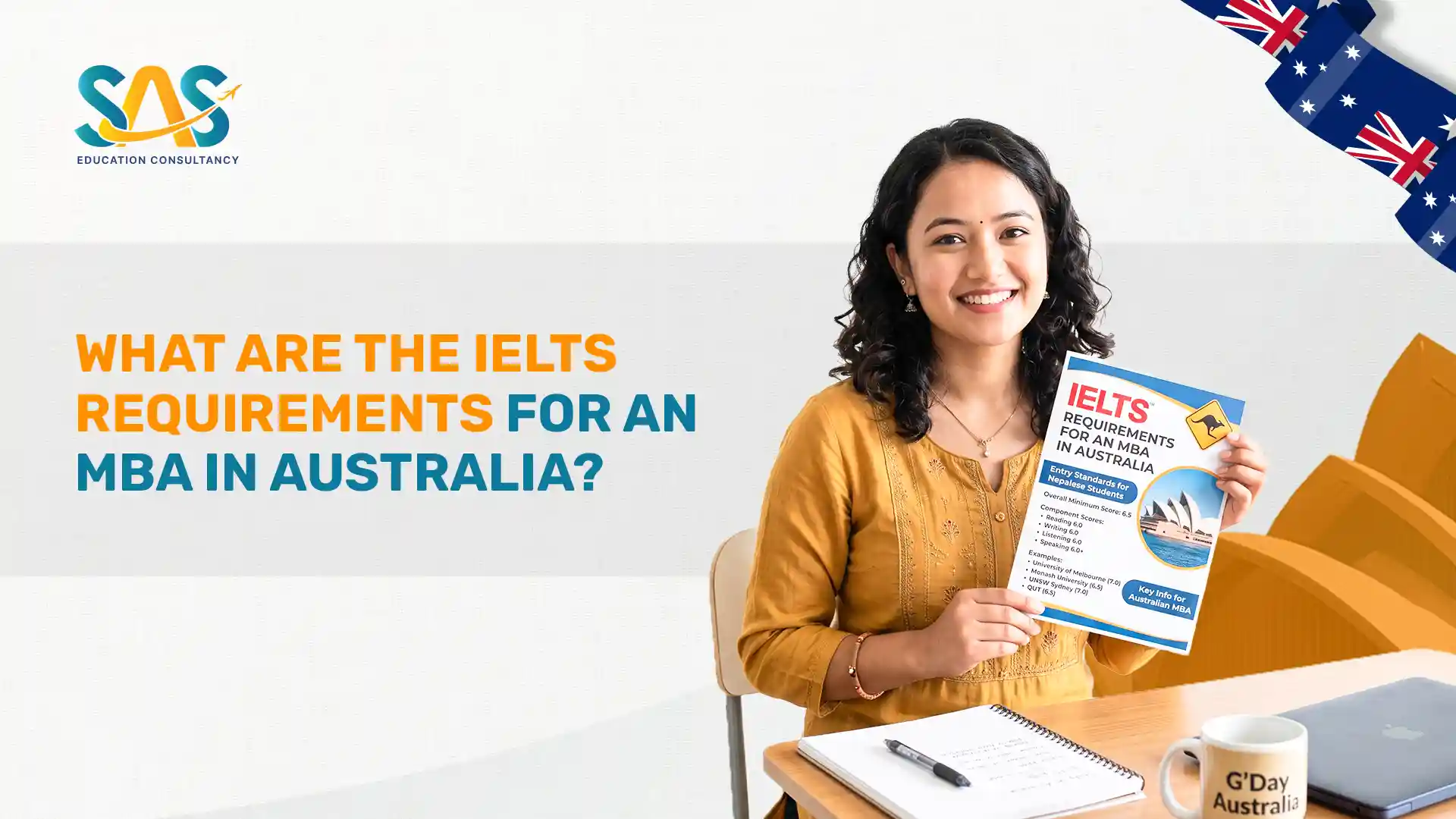
Most Australian MBA programs require an overall IELTS band score between 6.5 and 7.0, with a minimum of 6.0 in each individual section. Some competitive or research-focused MBA programs ask for a higher overall score, while others accept a slightly lower band with individual section minimums still enforced. The exact number depends on the specific university and the intensity of the MBA program.
| IELTS Component | Typical Minimum Score |
|---|---|
| Overall Band Score | 6.5 – 7.0 |
| Listening | 6.0 |
| Reading | 6.0 |
| Writing | 6.0 |
| Speaking | 6.0 |
- The overall band score is not the only requirement; each section usually has its own minimum
- A high overall score cannot always offset a low score in one section
- Requirements vary between universities and even between programs at the same university
- Most Australian universities specify IELTS Academic rather than IELTS General Training for MBA admission
Do You Need IELTS Academic to Study an MBA in Australia?
Yes, most Australian universities require IELTS Academic rather than IELTS General Training for MBA admission. IELTS Academic tests reading and writing skills suited to university-level study, which is why business schools prefer it over the General Training version. Some universities do accept alternative English tests, but the specific test type still needs to match what that program lists as acceptable.
- IELTS Academic is designed for university and postgraduate admissions
- IELTS General Training is intended for work or migration purposes, not typically accepted for MBA entry
- Universities specify IELTS Academic because it better reflects academic reading and writing demands
- Some programs accept alternatives to IELTS Academic, but these vary by university
- IELTS scores are generally valid for two years from the test date
- Score requirements and accepted test types should always be confirmed directly with the target university
Can You Study an MBA in Australia Without IELTS?
Yes, it is possible to study an MBA in Australia without IELTS if a university accepts an alternative English test or proof of prior English-medium education. Options like PTE Academic, TOEFL iBT, and Cambridge English qualifications are accepted by many Australian universities in place of IELTS. Some students may also qualify for exemptions or be directed toward an English pathway program before starting the MBA.
- PTE Academic, widely accepted as an IELTS alternative
- TOEFL iBT, accepted by many Australian business schools
- Cambridge English qualifications, accepted by select universities
- Proof of previous education completed fully in English, which may qualify for an exemption
- English pathway or bridging programs for students who do not yet meet the required score
- University-specific conditions that determine which alternatives are accepted
How Much Does an MBA in Australia Cost?
An MBA in Australia typically costs between AUD 40,000 and AUD 90,000 in total tuition, depending on the university and program length. On top of tuition, students need to budget for application fees, test costs, accommodation, and day-to-day living expenses. The total cost varies significantly based on the city, university reputation, and program duration.
| Expense Category | Estimated Cost Range |
|---|---|
| MBA Tuition Fees | AUD 40,000 – 90,000 (total program) |
| Application Fees | AUD 50 – 150 per university |
| IELTS/English Test Cost | AUD 300 – 400 |
| Accommodation | AUD 150 – 400 per week |
| Food and Transportation | AUD 150 – 300 per week |
| Health Insurance | AUD 500 – 700 per year |
Students researching Australia before applying should treat this as a working estimate, since fees and living costs shift year to year and vary widely between cities like Melbourne, Sydney, and smaller regional campuses.
How to Apply for an MBA in Australia as an International Student?
International students can apply for an MBA in Australia by choosing a suitable university, meeting admission requirements, preparing the required documents, submitting an application, accepting the offer, arranging finances, and applying for a student visa.
1. Choose the Right MBA University in Australia
Research Australian universities and choose an MBA program based on course fees, entry requirements, location, specialization, rankings, and career opportunities.
2. Check the MBA Eligibility Requirements
Check whether you meet the university’s requirements, which may include a bachelor’s degree, academic qualifications, work experience, and other admission criteria.
3. Check IELTS and English Language Requirements
Review the university’s English language requirements and check the minimum IELTS, PTE, TOEFL, or other accepted test scores.
4. Prepare Your Academic Documents
Prepare your academic certificates, transcripts, passport, English test results, and other documents required by the university.
5. Prepare Your CV and Statement of Purpose
Create an updated CV and Statement of Purpose (SOP) explaining your education, work experience, career goals, and reasons for choosing an MBA in Australia.
6. Take IELTS or Another Accepted English Test
Complete the required IELTS, PTE, TOEFL, or other accepted English language test and achieve the score required by your chosen university.
7. Submit Your MBA Application
Complete the university application form and submit your academic documents, CV, SOP, English test results, passport, and other required documents.
8. Receive Your MBA Offer Letter
If your application is successful, the university will send you an offer letter with details about your admission, course, fees, and conditions.
9. Arrange Your Finances and Required Documents
Prepare sufficient funds for tuition fees, living expenses, health insurance, travel, and other study-related costs before starting your visa application.
10. Apply for an Australian Student Visa
After meeting the university’s requirements, follow the current Australian student visa process and submit the required visa documents, financial evidence, health insurance, and other information.
11. Prepare for Your Departure to Australia
After your student visa is approved, arrange your flight, accommodation, travel documents, and other essentials before leaving for Australia.
What Documents Do You Need to Apply for an MBA in Australia?
To apply for an MBA in Australia, international students generally need academic, English language, personal, and financial documents. The exact requirements may vary by university and MBA program.
- Valid Passport: Provide a valid passport as proof of your identity and nationality.
- Bachelor’s Degree Certificate: Submit your bachelor’s degree certificate or equivalent qualification.
- Academic Transcripts: Provide official transcripts showing your academic performance and subjects studied.
- IELTS, PTE, or TOEFL Result: Submit your English language test score if required by the university.
- Updated CV/Resume: Include your education, work experience, skills, achievements, and professional background.
- Statement of Purpose (SOP): Explain your career goals, academic background, and why you want to study an MBA in Australia.
- Work Experience Documents: Provide employment letters, experience certificates, or other proof if work experience is required.
- Recommendation Letters: Submit academic or professional recommendation letters when required by the MBA program.
- Financial Documents: Provide the required financial evidence to demonstrate that you can support your study and living expenses.
- Other University-Specific Documents: Submit any additional documents requested by your chosen Australian university.
How to Prepare for IELTS for an Australian MBA
Preparing for IELTS effectively means testing current ability first, then building targeted skills before practicing under real exam conditions. Students who skip straight to practice tests without identifying weak areas often plateau below their target score. A structured preparation plan, broken into clear stages, produces more consistent results than random practice.
1. Diagnose Your Starting Point
Start with a full diagnostic or practice test to see where the current score sits against the required band. Use that result to identify which sections- listening, reading, writing, or speaking- need the most work. This step prevents wasted study time on skills that are already strong enough. A clear starting baseline also makes it easier to track progress over the following weeks.
2. Build Core Skills
Focus on academic and business vocabulary that shows up frequently in MBA-related reading and writing tasks. Practice academic reading passages regularly to build speed and comprehension under time pressure. Work on writing structure specifically, since IELTS Writing rewards clear organization as much as vocabulary. Improve speaking fluency by practicing out loud, not just reviewing notes silently.
3. Simulate Exam Conditions
Practice listening with a range of accents, since the real test includes speakers from multiple English-speaking countries. Take full timed mock tests close to the actual exam format to build stamina and pacing. Review every mistake carefully rather than moving on immediately, since patterns in errors reveal what still needs work. Repeating this cycle in the final weeks before the test is what typically closes the gap to the target score.
When Should You Apply for an MBA in Australia?
Most Australian MBA programs run on February and July intakes, though some universities offer additional intakes throughout the year. Application timelines usually need to start four to six months before the intended intake to allow time for IELTS preparation, document collection, and visa processing. Starting early gives enough buffer for retesting or resolving document issues without missing the intake deadline.
- February intake, the primary entry point for most programs
- July intake, a common secondary entry point
- Additional intakes offered by some universities outside these two windows
- IELTS preparation timeline, ideally starting two to three months before the test date
- University application timeline, usually submitted well ahead of the intake deadline
- Offer letter and visa processing time, which can take several weeks to a few months
- Early planning reduces the risk of missing a preferred intake due to delays
MBA in Australia: Intakes, Duration and Study Options
Australian MBA programs generally run for one to two years, with both full-time and part-time study options available depending on the university.
- MBA course duration typically ranges from 12 to 24 months
- Full-time programs suit students focused on completing the degree quickly
- Part-time programs suit students balancing work alongside study
- Major specializations include finance, marketing, human resources, and international business
- Intakes are generally offered in February and July, with some variation by university
- On-campus study remains the most common format, though some universities offer blended options
- Choosing between formats and specializations should align with long-term career goals, not just program length
Conclusion
IELTS is a real and important part of most Australian MBA applications, but it is only one checkpoint in a longer process that includes eligibility, documents, tuition planning, and visa timing. Students who treat the IELTS score as the finish line often lose momentum once they pass it, when in fact the university shortlist, document preparation, and intake timeline matter just as much to a successful application.
Students planning to pursue an MBA in Australia can work with SAS Education Consultancy to compare university requirements, prepare for IELTS, and build a complete application timeline from the first shortlist to the visa decision.