Master’s of IT in Australia for Foreign Students

Feb 17, 2026
Australia has quietly become one of the world’s strongest technology hubs, attracting global talent in software development, cybersecurity, artificial intelligence, and data science. For foreign students aiming to build an international tech career, studying in Australia offers more than just a degree, it offers industry exposure, global recognition, and strong post-study work opportunities. With rising demand for IT professionals and clear migration pathways, Australia is positioning itself as a launchpad for ambitious tech graduates.
In this blog on master’s of IT in Australia, we’ll break down eligibility criteria, admission requirements, top universities, specializations, tuition fees, scholarships, visa processes, career opportunities, and PR pathways. Whether you're comparing countries or finalizing your decision, this comprehensive guide is designed to help foreign students make an informed and confident choice about studying IT in Australia.
In this blog
What Is a Master's of IT in Australia?
A Master's of IT in Australia is a postgraduate degree designed to equip students with advanced technical knowledge and practical skills in information technology. The program typically covers areas such as software development, cybersecurity, data science, cloud computing, artificial intelligence, and IT project management. It is structured to prepare graduates for professional roles in the global technology industry.
Most Master of IT programs in Australia run for 1.5 to 2 years and combine theoretical learning with hands-on projects, internships, or capstone research. The curriculum is industry-focused, meaning students gain real-world exposure through case studies and technical labs. This degree is ideal for both IT graduates looking to specialize and students from related fields aiming to transition into the tech sector.
Why Study Masters of IT in Australia?
Studying a Master's of IT in Australia offers international students access to world-class education, strong industry connections, and excellent career prospects. Australia is home to globally ranked universities, advanced research facilities, and a thriving tech ecosystem. The country also provides post-study work opportunities and clear pathways toward permanent residency for eligible graduates. Combined with a multicultural environment and high quality of life, Australia has become a preferred destination for IT aspirants worldwide.
1. Globally Ranked Universities and Research Excellence
Australia hosts several internationally recognized universities known for excellence in technology and innovation. Institutions such as the University of Melbourne and the Australian National University consistently rank among the top globally for computer science and IT. These universities offer cutting-edge research facilities, experienced faculty, and industry-driven projects. Students benefit from exposure to advanced technologies, collaborative research, and global academic networks. A degree from a reputed Australian university carries strong international credibility.
2. Industry-Focused Curriculum and Practical Learning
Master of IT programs in Australia are designed with strong industry alignment. The curriculum includes hands-on labs, real-world case studies, capstone projects, and internship opportunities. Many universities collaborate with tech companies to ensure students gain practical experience before graduation. This industry exposure enhances employability and prepares students for real workplace challenges. Graduates leave not just with theory, but with applied technical skills that employers value.
3. Strong Demand for IT Professionals in Australia
Australia’s digital economy is expanding rapidly, creating high demand for skilled IT professionals. Roles such as software developer, cybersecurity analyst, data scientist, and cloud engineer are consistently listed on the Skilled Occupation List (SOL). The country faces ongoing skill shortages in technology-related fields, increasing job prospects for graduates. Completing a Master's of IT in Australia positions students well within this competitive job market. Strong employment rates and attractive salaries make the degree a worthwhile investment.
4. Post-Study Work Visa and PR Pathways
International students completing a Master of IT in Australia may be eligible for post-study work rights under the Temporary Graduate Visa (Subclass 485). This allows graduates to gain valuable Australian work experience after completing their degree. Many IT occupations are included in migration pathways, offering potential routes toward permanent residency (PR). With relevant work experience and skills assessment, graduates can apply through skilled migration programs. These pathways make Australia appealing for students seeking long-term career and settlement opportunities.
Need Help to Apply for Your Australian Student Visa?
Get expert guidance on courses, universities, scholarships, and applications. Start your Australian education journey with out crertified counsellors today!
Master’s of IT in Australia for International Students
A masters of IT in Australia is highly accessible to international students, provided they meet academic, language, and visa requirements. Australian universities maintain transparent admission criteria and follow globally recognized academic standards. The application process is structured but straightforward when planned properly. Understanding eligibility, documentation, and visa procedures in advance can significantly improve your chances to study in Australia and gaining admission.
1. Eligibility Criteria for Foreign Students
International students must meet university-specific admission requirements to enroll in a Master of IT program. Generally, applicants need a recognized bachelor’s degree and proof of English proficiency. Some universities may also require a relevant academic background in IT, computer science, or related disciplines. Certain institutions offer bridging programs for non-IT graduates. Meeting minimum entry criteria does not guarantee admission, as competition can be strong at top universities.
2. Academic Background and GPA Requirements
Most universities require a bachelor’s degree equivalent to an Australian undergraduate qualification. A minimum GPA (usually 60–70% or equivalent) is expected, though top universities may require higher scores. Applicants with degrees in IT, computer science, engineering, or related technical fields are typically preferred. Some programs accept students from non-IT backgrounds but may require foundational units. Strong academic performance enhances admission prospects significantly.
3. English Language Requirements (IELTS, TOEFL, PTE)
Since courses are delivered in English, international students must demonstrate language proficiency. Commonly accepted tests include IELTS, TOEFL iBT, and PTE Academic. Most universities require an overall IELTS score of 6.5 with no band below 6.0, though requirements may vary. Equivalent TOEFL or PTE scores are also accepted. Meeting English requirements is essential for both university admission and student visa approval.
4. Australian Student Visa (Subclass 500) Process
International students must apply for the Australian Student Visa (Subclass 500) after receiving their Confirmation of Enrolment (CoE). The visa application requires proof of admission, financial capacity, English proficiency, and Overseas Student Health Cover (OSHC). Applicants must also meet Genuine Student (GS) requirements. Visa processing times vary, so early preparation is advisable. Once approved, the visa allows students to study full-time and work limited hours during the semester.
Popular Specializations in Master's of IT in Australia
One of the biggest advantages of pursuing a Master's of IT in Australia is the wide range of in-demand specializations available. Australian universities design their IT programs to align with global technology trends and industry shortages. Students can tailor their degree toward high-growth areas such as cybersecurity, artificial intelligence, cloud computing, and IT management. Choosing the right specialization not only enhances employability but also strengthens long-term career prospects in Australia and internationally.
1. Cybersecurity and Information Security
Cybersecurity is one of the fastest-growing IT fields worldwide. This specialization focuses on protecting networks, systems, and data from cyber threats and attacks. Students learn about ethical hacking, digital forensics, cryptography, and risk management. With increasing cybercrime and data breaches, organizations actively seek skilled security professionals. Graduates can work as cybersecurity analysts, security consultants, or information security managers. The demand for cybersecurity experts remains consistently strong in Australia.
2. Data Science and Artificial Intelligence
Data science and AI specialization prepare students to analyze large datasets and develop intelligent systems. The curriculum includes machine learning, big data analytics, statistical modeling, and predictive algorithms. Businesses across industries rely on data-driven decision-making, increasing demand for data professionals. Graduates can pursue roles such as data scientist, AI engineer, or machine learning specialist. This field offers strong salary potential and global career mobility.
3. Software Engineering and Application Development
This specialization focuses on designing, developing, and maintaining software applications. Students gain skills in programming languages, system architecture, mobile app development, and software testing. Practical projects and coding assignments form a major part of the coursework. Graduates are prepared for roles such as software developer, full-stack developer, or systems engineer. Software engineering remains one of the most stable and high-demand IT career paths in Australia.
4. Cloud Computing and DevOps
Cloud computing and DevOps concentrate on managing cloud infrastructure and automating software deployment processes. Students learn about platforms such as AWS, Azure, containerization, and continuous integration tools. As companies shift to cloud-based solutions, expertise in this area is increasingly valuable. Graduates can work as cloud engineers, DevOps specialists, or infrastructure architects. This specialization combines technical depth with practical implementation skills.
5. Business Information Systems and IT Management
This specialization bridges technology and business strategy. Students study IT project management, enterprise systems, digital transformation, and business analytics. It is ideal for those interested in leadership or managerial roles within the tech industry. Graduates often pursue careers as IT consultants, business analysts, or IT project managers. This pathway is well-suited for students aiming to combine technical expertise with strategic decision-making.
Top Universities Offering Master's of IT in Australia
Australia is home to several globally ranked universities that offer high-quality IT postgraduate programs. These institutions are recognized for academic excellence, research innovation, and strong industry connections. Choosing the right university significantly impacts career outcomes after completing a Master's of IT in Australia. Below are some of the top Australian universities preferred by international students for advanced IT studies.
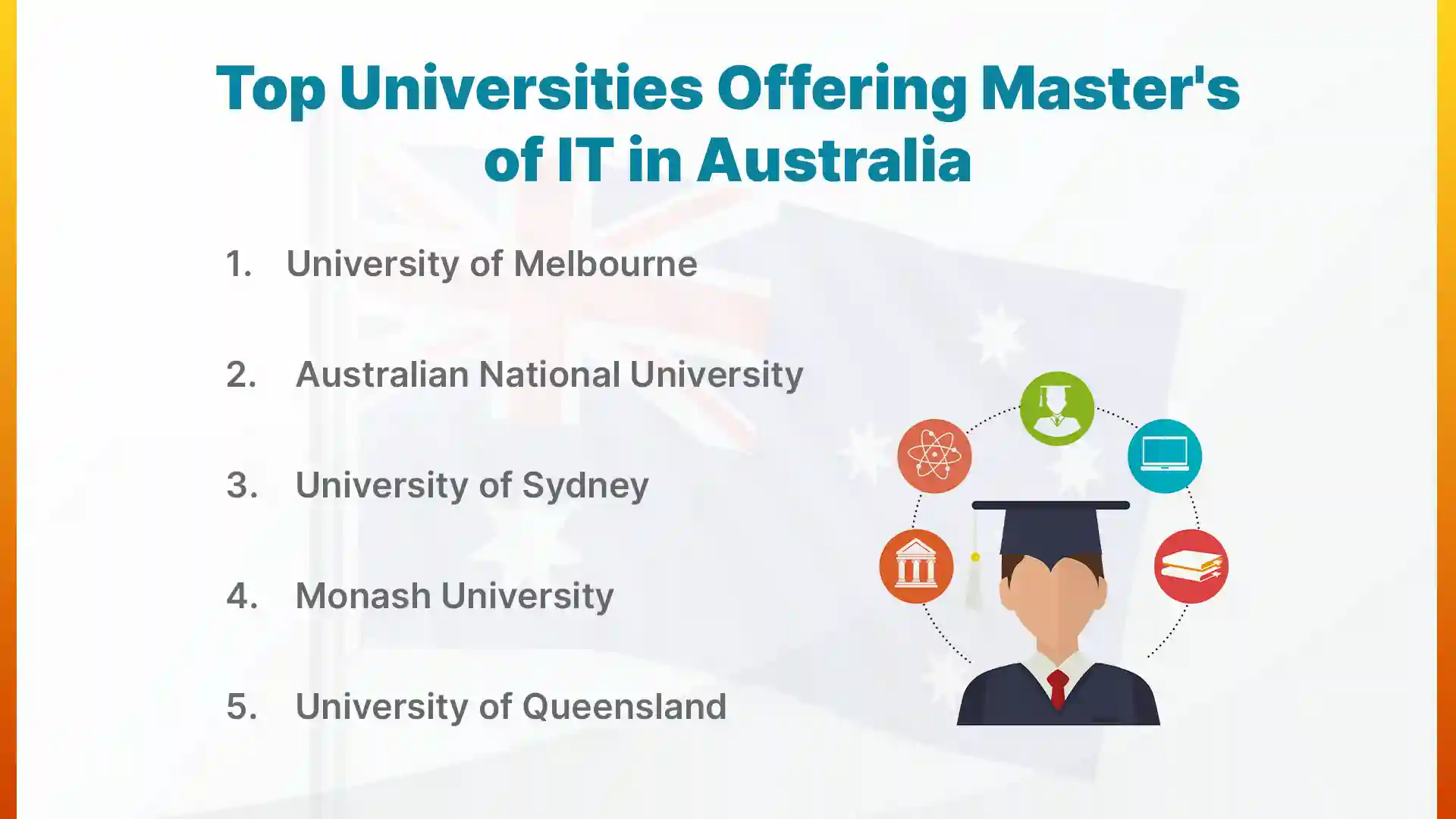
1. University of Melbourne
The University of Melbourne is consistently ranked among the top universities globally. Its Master of IT program focuses on advanced computing, artificial intelligence, and data science. The university is known for strong research output and global academic collaborations. Students benefit from modern laboratories, industry exposure, and practical learning opportunities. Graduates enjoy strong employability outcomes both within Australia and internationally.
2. Australian National University
Australian National University (ANU) is widely respected for its research-driven teaching and academic rigor. Its IT programs emphasize cybersecurity, machine learning, and advanced computing systems. Located in Canberra, the university provides access to government and research institutions. ANU offers a strong academic environment supported by experienced faculty members. It is particularly suitable for students interested in research and innovation-focused careers.
3. University of Sydney
The University of Sydney delivers industry-aligned IT programs with a strong practical orientation. Its curriculum integrates emerging technologies such as cloud computing, big data, and artificial intelligence. The university maintains close ties with leading technology firms, enhancing internship and employment opportunities. Students gain hands-on experience through real-world projects and collaborative coursework. The institution’s global reputation adds significant value to graduates’ profiles.
4. Monash University
Monash University is known for innovation and strong global rankings in information technology and computer science. Its Master of IT programs offer flexible specializations, allowing students to customize their academic pathway. The university emphasizes applied learning, industry engagement, and research excellence. Monash also hosts specialized research centers in cybersecurity and data science. Graduates frequently secure competitive roles in Australia’s expanding technology sector.
5. University of Queensland
The University of Queensland (UQ) offers comprehensive IT programs that balance theoretical knowledge with practical application. Its areas of strength include software engineering, artificial intelligence, and data analytics. UQ collaborates closely with industry partners to provide internships and research opportunities. The university attracts a large international student population due to its supportive learning environment. A degree from UQ is well-recognized in both domestic and international job markets.
Course Structure and Duration of Masters of IT in Australia
A masters of IT in Australia is structured to provide a mix of theoretical knowledge, practical skills, and industry exposure. Programs typically last between 1.5 to 2 years for full-time international students. Australian universities design their courses to align with global IT industry standards, ensuring students gain both technical expertise and problem-solving skills. The curriculum usually combines core subjects, electives, practical projects, and optional internships, allowing students to tailor their learning to their career goals.
1. Course Duration (1.5-2 Years Full-Time)
Most Master of IT programs in Australia are completed in 1.5 to 2 years of full-time study. Some universities offer accelerated or part-time options for working professionals. The shorter duration compared to other countries makes Australia an attractive choice for international students seeking quality education in less time. Students can also include practical components like internships or research projects during this period. The program is intensive but designed to prepare graduates for fast-entry into the technology workforce.
2. Core Subjects and Elective Modules
The curriculum typically includes core subjects such as advanced programming, cybersecurity, database management, cloud computing, and data analytics. Elective modules allow students to specialize in areas like artificial intelligence, IT project management, or software engineering. Universities offer flexibility to choose electives based on individual career goals. This combination ensures students develop both foundational knowledge and expertise in emerging technologies. It also helps them stand out in competitive global IT job markets.
3. Capstone Projects, Research, and Industry Internships
Many Master of IT programs require students to complete a capstone project, research dissertation, or industry internship. These practical experiences allow students to apply theoretical knowledge to real-world IT challenges. Internships or industry placements help build professional networks and increase employability. Research projects develop problem-solving, analytical, and technical skills, often aligned with current industry trends. Completing such hands-on components gives students a competitive edge when entering the IT workforce.
How to Apply for Masters of IT in Australia? Step-by-Step
To apply for a Master's of IT in Australia, you must follow a clear step-by-step process that ensures eligibility, proper documentation, and timely visa approval. Planning, understanding university requirements, and preparing all necessary academic and personal documents can make the application smoother. Following these steps carefully increases your chances of securing admission at a top Australian university and obtaining your student visa without delays.
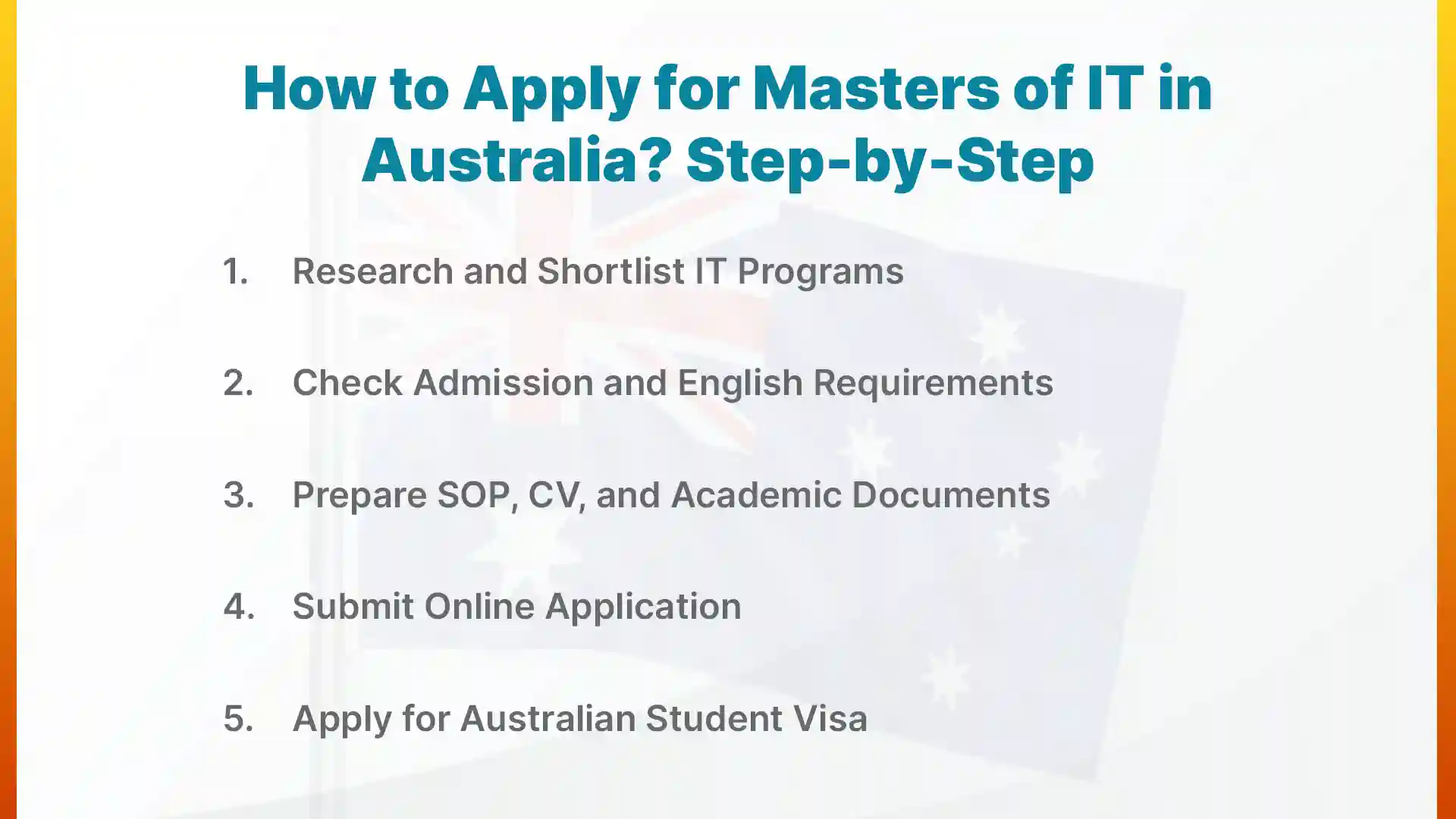
1. Research and Shortlist IT Programs
Begin by researching universities that offer Master of IT programs aligned with your career goals. Consider program specializations, faculty expertise, rankings, and industry connections. Shortlist programs that match your interests and future career aspirations. Take note of application deadlines and tuition fees. Comparing multiple programs helps you choose the best fit for both academic quality and financial feasibility.
2. Check Admission and English Requirements
Review each university’s eligibility criteria, including academic qualifications, GPA requirements, and prerequisite courses. International students must meet English language proficiency requirements through IELTS, TOEFL, or PTE scores. Some programs may require prior IT-related experience or technical knowledge. Understanding these requirements beforehand avoids application rejection and ensures you are fully prepared.
3. Prepare SOP, CV, and Academic Documents
Prepare a strong Statement of Purpose (SOP) that highlights your academic achievements, career goals, and motivation for pursuing a Master of IT. Update your CV to emphasize relevant experience, skills, and internships. Gather transcripts, degree certificates, recommendation letters, and English test scores. Ensure all documents are properly formatted and certified, as incomplete or incorrect submissions can delay processing.
4. Submit Online Application
Complete the online application for each university on their official portal. Attach all required documents, pay the application fee, and double-check personal information for accuracy. Some universities may require additional forms or questionnaires. After submission, track the application status and respond promptly to any university communications to avoid delays.
5. Apply for Australian Student Visa
Once you receive your Confirmation of Enrolment (CoE), apply for the Australian Student Visa (Subclass 500). Submit evidence of financial capacity, English proficiency, and health insurance (OSHC). Meet the Genuine Student requirements and provide biometrics if required. Visa processing can take several weeks, so apply early. Approval allows full-time study and limited work during semesters, providing valuable industry exposure.
Admission Requirements for Masters of IT in Australia
To secure admission for a Master's of IT in Australia, international students must meet specific academic, language, and documentation requirements. Universities assess your previous qualifications, English proficiency, and professional readiness to ensure you can handle the program’s rigorous curriculum. Proper preparation of supporting documents, including SOPs and recommendation letters, plays a crucial role in a successful application. Meeting these requirements early can streamline your admission process and improve your chances at top-ranked institutions.
1. Recognized Bachelor’s Degree (IT or Related Field)
A recognized bachelor’s degree in IT, computer science, or a related field is typically required. Universities may also consider applicants with degrees in engineering, mathematics, or other technical disciplines if they demonstrate strong IT knowledge. Your undergraduate performance, especially in core computing subjects, is closely evaluated. Some programs may require prerequisite courses or foundational knowledge in programming, networking, or databases.
2. English Language Test Scores
International students must demonstrate proficiency in English through standardized tests like IELTS, TOEFL, or PTE. Minimum scores vary by university, but generally, an IELTS score of 6.5 overall with no band below 6.0 is expected. English proficiency ensures you can actively participate in lectures, understand complex technical materials, and complete assignments effectively. Some universities may waive this requirement for students who have completed prior education in English.
3. Statement of Purpose (SOP)
A well-written SOP for Australia is essential to convey your academic goals, career aspirations, and motivation for pursuing a Master of IT in Australia. It should highlight your relevant experience, skills, and achievements. Universities use the SOP to gauge your seriousness, research interests, and alignment with the program. A compelling SOP can distinguish your application from others and improve your admission chances.
4. Letters of Recommendation (LORs)
Most universities require 2–3 recommendation letters from academic professors or professional supervisors. LORs should vouch for your technical skills, academic aptitude, work ethic, and suitability for graduate-level IT studies. Strong LORs provide credibility to your application and showcase your potential to succeed in a challenging program. Choosing recommenders who know your capabilities well is critical.
5. Work Experience (Optional but Preferred)
While not mandatory, prior IT work experience, internships, or research projects can strengthen your application. Practical exposure to software development, cybersecurity, data analytics, or IT project management demonstrates readiness for advanced studies. Universities value applicants who can apply theoretical knowledge in real-world settings, making experienced candidates more competitive. Even short-term internships or volunteer projects can add significant weight.
Cost of Studying Masters of IT in Australia
Studying a Master's of IT in Australia is a significant investment, but it comes with world-class education, industry exposure, and strong career prospects. Costs include tuition, living expenses, health insurance, and other personal expenditures. Planning and budgeting properly ensures a smooth academic experience without financial stress.
1. Tuition Fees for IT Programs
Tuition for Master of IT programs generally ranges from AUD 28,000 to AUD 50,000 per year for international students. Top-ranked universities like the University of Melbourne, Monash, or ANU may charge on the higher side. Over a 2-year full-time program, total tuition can range from approximately AUD 56,000 to over AUD 100,000. Fees cover access to labs, libraries, software, and other learning resources.
2. Living Expenses in Australia
International students should budget around AUD 25,000–30,000 per year for living expenses. This includes accommodation, food, transportation, utilities, and leisure activities. Health insurance (OSHC) is mandatory and typically adds a few hundred dollars annually. Costs vary depending on the city; for example, Sydney and Melbourne are more expensive than Brisbane or Canberra. Proper planning can balance comfort with affordability.
3. Estimated Total Cost for International Students
Combining tuition and living expenses, a 2-year Master of IT program in Australia can cost roughly AUD 80,000–130,000. This total estimate accounts for accommodation, food, health insurance, study materials, and personal expenses. While the investment is substantial, it reflects access to global-standard education, networking opportunities, and career pathways in Australia’s thriving IT sector.
Scholarships for Master's of IT in Australia
Studying a Master's of IT in Australia can be expensive, but scholarship in Australia and financial aid programs can significantly reduce the financial burden. Both the Australian government and individual universities offer various funding options for international students. Scholarships reward academic excellence, leadership, or financial need, making them highly competitive but worth pursuing. Planning early and understanding eligibility criteria increases your chances of securing support.
1. Australian Government Scholarships
The Australian government offers scholarships like the Australia Awards or Destination Australia Scholarships for international students. These scholarships may cover tuition, living costs, and even travel expenses. They are highly competitive, awarded to candidates with strong academic records, leadership qualities, and community involvement. Applying early and preparing a strong application can improve your chances of success.
2. University-Specific Scholarships
Many universities provide their own scholarships for Master of IT students. These may be merit-based, need-based, or tailored for students from specific countries or regions. University scholarships often cover partial or full tuition fees and sometimes living allowances. Each university sets its eligibility criteria, so students should carefully review the options available at their chosen institutions.
3. Merit-Based and Need-Based Financial Aid
Merit-based scholarships reward outstanding academic achievements, research excellence, or industry accomplishments. Need-based scholarships consider financial circumstances to help students who might otherwise struggle to afford tuition. Some programs combine both approaches. Providing strong supporting documents, like transcripts and personal statements, can increase your chances of being awarded financial assistance.
4. Tips to Increase Scholarship Approval Chances
To improve scholarship approval chances, maintain high academic performance and highlight leadership or industry experience in applications. Craft a compelling Statement of Purpose and gather strong recommendation letters. Apply early, meet all deadlines, and tailor applications for each scholarship. Demonstrating motivation, clear career goals, and alignment with scholarship objectives often makes your application stand out.
Career Opportunities After Masters of IT in Australia
Completing a Master's of IT in Australia opens doors to a wide range of high-demand technology roles. The program equips students with advanced technical skills, problem-solving abilities, and industry-ready knowledge. Graduates can enter the IT workforce in Australia or internationally, benefiting from the country’s growing tech ecosystem. With a strong global reputation, this degree enhances employability, provides exposure to innovative projects, and offers pathways to post-study work visas or permanent residency.
1. Software Developer and Systems Analyst
Software developers design, test, and maintain applications and systems for businesses, tech companies, and startups. Systems analysts evaluate existing IT systems, propose improvements, and implement solutions to enhance efficiency. Graduates with programming, software engineering, and analytical skills are in high demand. Roles may involve working on web development, enterprise applications, or mobile solutions. Hands-on internships during the degree often help secure these positions.
2. Cybersecurity Analyst and Cloud Engineer
Cybersecurity analysts protect organizations from cyber threats by monitoring networks, implementing security protocols, and responding to incidents. Cloud engineers design, manage, and optimize cloud-based infrastructure and services. These roles are increasingly vital as companies migrate to digital platforms. Graduates with expertise in cloud computing, network security, and risk assessment have excellent career prospects. Certifications like CISSP or AWS can further boost opportunities.
3. Data Scientist and AI Specialist
Data scientists and AI specialists analyze large datasets to derive actionable insights and develop predictive models. They work with machine learning algorithms, statistical methods, and data visualization tools. AI specialists focus on designing intelligent systems, automation, and natural language processing. Master of IT graduates with strong analytical, coding, and research skills are highly sought after in finance, healthcare, e-commerce, and tech startups.
4. IT Consultant and Business Analyst
IT consultants advise organizations on technology strategies, system improvements, and digital transformation. Business analysts bridge the gap between IT teams and business stakeholders by identifying requirements and optimizing processes. Graduates with problem-solving abilities, communication skills, and technical knowledge excel in these roles. These positions often involve project management, stakeholder engagement, and implementing innovative IT solutions across industries.
Scope of Masters of IT in Australia for PR and Migration
Master's of IT in Australia not only provides advanced technical skills but also offers pathways for skilled migration and long-term career growth. Australia’s growing IT sector actively seeks qualified professionals, making IT graduates eligible for post-study work opportunities and Permanent Residency (PR). Taking up part-time jobs in Australia while studying can help you gain industry experience, support your living expenses, and strengthen your resume. Understanding immigration pathways and the skilled occupation demand ensures you can plan your career and migration strategically.
1. Skilled Occupation List (SOL) and IT Roles
Many IT-related roles, including software engineers, cybersecurity specialists, and data analysts, are listed on Australia’s Skilled Occupation List (SOL). Being on the SOL makes graduates eligible for skilled migration visas. Employers also actively recruit candidates from this list, increasing your chances of landing a high-demand job. This alignment between study and national workforce demand strengthens both career and migration prospects.
2. Post-Study Work Visa Options
International students who complete a Master of IT in Australia can apply for the Temporary Graduate Visa (Subclass 485). This visa allows 2-3 years of full-time work, depending on the level of study. It provides valuable work experience, a chance to network with employers, and time to prepare for permanent residency applications. Post-study work experience can also enhance employability in competitive IT roles.
3. Pathways to Permanent Residency (PR)
After gaining post-study work experience, IT graduates can apply for PR through skilled migration programs like the General Skilled Migration (GSM) or Employer-Sponsored visas. Points are awarded for qualifications, age, work experience, and English proficiency. Securing PR offers long-term stability, higher earning potential, and the freedom to live and work anywhere in Australia. Strategic planning of career steps post-graduation is key to maximizing these opportunities.
Is Masters of IT in Australia Worth It for Foreign Students?
Yes, a master’s of IT in Australia is worth it for international students because it combines advanced technical knowledge with global recognition, high employability, and strong career growth. Graduates gain exposure to Australia’s booming tech industry, practical skills through internships, and opportunities for post-study work visas or permanent residency. The investment may be substantial, but the potential returns in career progression, salary, and international experience make it worthwhile.
- High demand for IT professionals in cybersecurity, AI, data science, and cloud computing.
- Access to globally ranked universities and cutting-edge research facilities.
- Opportunity for post-study work visas (2–3 years) to gain professional experience.
- Pathway to permanent residency in Australia through skilled migration programs.
- Competitive starting salaries ranging from AUD 60,000 to 90,000+, depending on specialization.
- International exposure and networking with global tech companies and startups.
- Strong long-term career growth with opportunities to transition into leadership and consulting roles.
Which Education Consultancy Is Best for Studying Master’s in Australia?
SAS Education Consultancy is widely regarded as one of the best consultancies for international students planning to study a Master’s of IT in Australia. They provide personalized, end‑to‑end guidance, from selecting the right program and university to helping with applications, scholarships, SOPs, and visa documentation. Their experienced team understands both student expectations and Australian immigration requirements, which helps minimize errors and delays. SAS also offers pre‑departure support and post‑arrival assistance, making the entire journey smoother. With a strong track record of successful placements and satisfied students, SAS Education Consultancy combines professionalism with a friendly, supportive approach to make your study‑abroad dream a reality.
Conclusion
Pursuing a Master's of IT in Australia offers international students a unique blend of high-quality education, industry exposure, and global career opportunities. From gaining advanced technical skills in areas like AI, cybersecurity, and cloud computing to learning from world-class universities, this degree equips graduates to meet the demands of a rapidly evolving tech landscape. Additionally, Australia’s post-study work visa and skilled migration pathways provide a chance to gain practical experience while paving the way for long-term career growth and permanent residency.
Careful planning, selecting the right specialization, and leveraging scholarships or consultancies like SAS Education Consultancy can maximize your success. With dedication, strong skills, and strategic guidance, pursuing a Master’s of IT in Australia can be a life-changing investment in your professional and personal future.