Public vs. Private University in Australia: Which Should Nepali Students Choose?

Jul 31, 2026
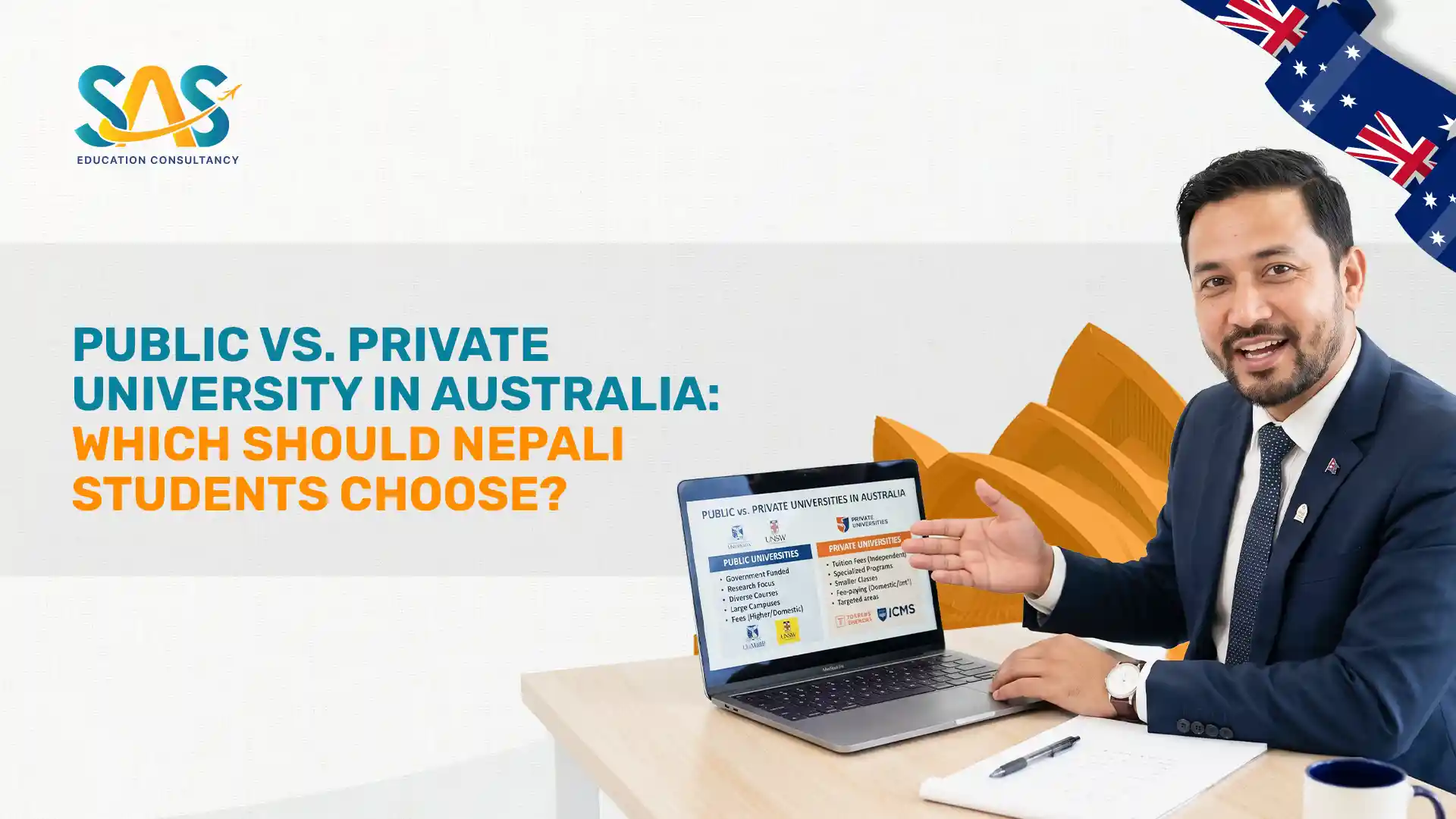
Choosing between a public and private university is one of the first major decisions Nepali students face when planning to study in Australia. Both paths lead to internationally recognized, TEQSA-accredited degrees, but they differ sharply in cost, admission timelines, research depth, and how graduates are viewed by employers and immigration authorities.
With 2026 bringing tighter visa rules, higher tuition costs, and a revised skilled occupation list, the choice matters more than ever for financial and migration planning. This guide breaks down the real differences with current fee ranges, named institutions, and visa specifics to help you choose the option that fits your budget, course interest, and PR goals. Students thinking of planning to study in Australia should prepare a year ahead and check all the necessary parts to get admission to Australia.
In this blog
Public Universities in Australia
Public universities in Australia are government-funded, research-intensive institutions regulated by the Tertiary Education Quality and Standards Agency (TEQSA) and typically ranked among the world's top 500.
Nepal's most common public university destinations include the Group of Eight (Go8) University which are the University of Melbourne, the Australian National University (ANU), the University of Sydney, UNSW Sydney, Monash University, the University of Queensland, the University of Adelaide, and the University of Western Australia alongside strong mid-tier public options like the University of South Australia, Deakin University, and RMIT. Public universities dominate Australia's research output, host most PhD and Research Training Program (RTP) placements, and generally carry more weight with Nepali employers and banks assessing loan applications, largely because of their long institutional history and name recognition.
Private Universities in Australia
Private universities in Australia are independently funded, industry-aligned institutions that are still fully CRICOS-registered and TEQSA-accredited, meaning their degrees carry the same legal recognition as public ones.
Torrens University Australia, Bond University, and James Cook University's Brisbane campus are among the most common private destinations for Nepali students, largely because of faster processing, multiple intakes per year, and strong placement support in fields like business, hospitality management, and IT. Private institutions tend to run smaller cohorts and often bundle career-services support directly into tuition, which suits students who need more one-on-one guidance adjusting to an international campus for the first time.
Why the Public vs. Private Choice Matters for Nepali Students
The public vs. private university choice matters for Nepali students because it directly affects total tuition cost, loan and NOC approval, intake flexibility, and long-term visa and PR planning.
1. Tuition costs vary significantly between the two.
A public Go8 engineering degree can cost more than double a private university business degree, which changes how much your family needs to arrange through NOC-linked loans or savings.
2. Global rankings tend to favor public universities.
Employers and government bodies in Nepal often still weigh QS/THE rankings when evaluating returning graduates for senior roles.
3. Private universities offer faster, more flexible intakes.
While standard intakes in Australia generally revolve around two main periods, private universities offer up to four intakes a year. This suits students who missed the February/July public university deadlines or need to start their visa process sooner.
4. Class sizes and support structures differ meaningfully by institution type.
Students who need closer academic guidance in their first semester often adjust faster in smaller private cohorts of 20–40 students versus lecture halls of 200+ at large public campuses.
Both public universities and private universities are TEQSA-accredited and CRICOS-registered, but public universities generally rank higher in global league tables like the QS World University Rankings and the Times Higher Education (THE) World University Rankings.
Benefits of Choosing a Public University
Benefits of choosing a public university in Australia include lower cost-per-ranking value, stronger research funding, wider scholarship access, and easier loan and NOC processing back home
Lower cost-per-ranking value Go8 universities offer world-Top-100 recognition at fees still below many private MBA programs
Access to the Research Training Program (RTP) and PhD scholarships not typically available at private institutions
Larger, more established alumni networks across Nepal, useful for job referrals after returning home
Broader scope of double-degree and exchange programs
Generally stronger acceptance among Nepali banks for education loan processing due to long-standing institutional recognition
Benefits of Choosing a Private University
Benefits of choosing a private university in Australia include faster and more flexible intakes, smaller class sizes, an industry-aligned curriculum, and dedicated career-services support.
Up to four intakes per year, useful for students with tight NOC or IELTS timelines
Smaller cohorts (often 20–40 students per class) with direct instructor access
Curriculum co-designed with industry partners in fields like business, hospitality, and IT
Dedicated career-services teams are often built into the tuition fee
Generally faster document turnaround and offer-letter processing, useful for last-minute intake changes
How to Choose the Right Option for You
The right choice depends on weighing your budget, course goals, and visa timeline against what each institution type actually offers, not on reputation alone. Knowing
Budget: Total annual cost (tuition plus living) runs roughly AUD 45,000–90,000 depending on city and institution; confirm this against your family's loan capacity before shortlisting
Course and career path: Research-heavy fields (medicine, engineering, pure sciences) lean toward public Go8 universities; business, hospitality, and IT are well served by private institutions like Torrens or Bond
Ranking priorities: Decide how much QS/THE ranking matters for your specific career goals versus faster completion or smaller class sizes
Visa and PR pathway: Confirm your course and occupation appear on the 2026 Core Skills Occupation List before enrolling
Campus location: Regional campuses (including some Go8 satellite campuses) can add 1–2 extra years of post-study work rights under the subclass 485 regional bonus
Intake flexibility: If your NOC or IELTS score isn't ready for a February/July public intake, a private university's May or October intake may save you a full year
NOC and loan requirements: Nepali banks generally process education loans faster for institutions with a longer accreditation history, so confirm this with your consultancy before applying
English test scores: As of 2026, most institutions require IELTS 6.0–6.5 overall for undergraduate entry, and the subclass 485 post-study visa now requires IELTS 6.5 overall (up from 6.0)
Cost Comparison (Tuition and Living)
As of 2026, most Nepali students studying in Australia spend between AUD 45,000 and AUD 90,000 per year once tuition and living costs are combined. Understanding the total cost to study in Australia is the first step in deciding if a public or private institution fits your budget.
Undergraduate tuition: AUD 20,000–45,000 per year at most institutions; the median undergraduate fee sits around AUD 38,500
Postgraduate coursework: AUD 22,000–50,000 per year; the median postgraduate fee sits around AUD 44,000
Specialized Go8 programs (medicine, engineering, MBA): AUD 60,000–95,000+ per year
VET diplomas and some private-college pathways: AUD 12,000–28,000 per year, a notably cheaper entry route than a full bachelor's degree
Living costs: the Department of Home Affairs' 2026 minimum financial capacity requirement for a student visa (subclass 500) is AUD 29,710 per year, though actual spending in Sydney or Melbourne often runs AUD 25,000–30,000 annually
Student visa (subclass 500) application fee: AUD 2,000 for the primary applicant, as of February 2026
Scholarships, part-time work in Australia (up to 48 hours per fortnight during the term), and Nepali bank education loans can meaningfully offset these totals.
What Scholarships Are Available?
Nepali students can access a mix of university-specific, government, and consultancy-assisted scholarships to reduce the overall cost of studying in Australia, at both public and private institutions.
University-specific merit scholarships offering fee waivers typically between 15% and 50%, based on academic performance
The Destination Australia Scholarship, a government-backed award for students studying at select regional campuses
The Research Training Program (RTP), which provided eligible research students with stipends around AUD 35,000 per year in 2026, available mainly through public universities
Early-bird tuition discounts and loyalty scholarships offered by several private universities, including Torrens and JCU
Consultancy-assisted scholarship matching based on your academic profile, target course, and campus location
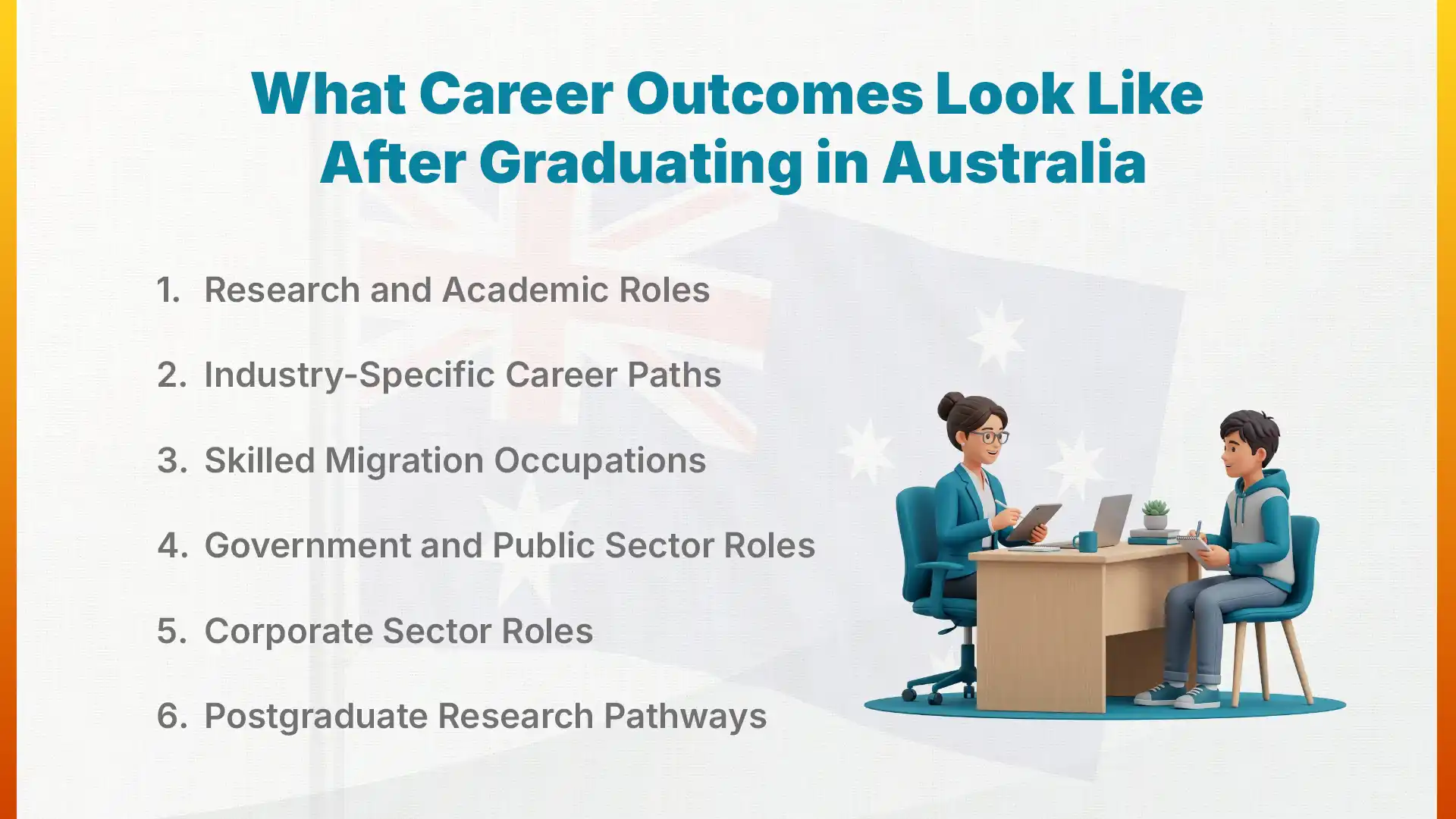
What Career Outcomes Look Like After Graduating in Australia
Career outcomes after graduating in Australia depend mainly on your course and occupation code rather than institution type, with both public and private graduates eligible for research, industry, and skilled migration pathways.
1. Research and academic roles
Access to RTP funding and established research labs at Go8 universities often leads directly into PhD or academic career pathways. Graduates in these roles often go on to publish research or teach at the university level, both in Australia and after returning to Nepal.
2. Industry-specific career paths
Private institutions design curricula with direct industry input, which eases entry into business, hospitality, and IT roles straight after graduation.
Skilled migration occupations Graduates from both institution types can apply for the subclass 485 visa, provided their occupation sits on the 2026 Core Skills Occupation List (CSOL), which includes registered nursing, civil/mechanical/electrical engineering, and select IT roles.
3. Government and public sector roles
Graduates from both institution types can apply for the subclass 485 visa, provided their occupation sits on the 2026 Core Skills Occupation List (CSOL), which includes registered nursing, civil/mechanical/electrical engineering, and select IT roles. Matching your course to a CSOL-listed occupation early is one of the most important steps for a smoother PR pathway later.
5. Corporate Sector Roles
Employers typically weigh coursework relevance and internship experience more heavily than whether the institution was public or private. Building work experience during your studies, through internships or part-time roles, often matters more to employers than the university's ranking.
6. Postgraduate research pathways
The stronger research infrastructure and PhD scholarship access at public universities makes them the more common next step for students planning further study. Students aiming for this pathway should confirm RTP eligibility and supervisor availability before applying.
Visa, PR, and Post-Study Work Considerations
Graduates of both public and private CRICOS-registered institutions can apply for the Temporary Graduate visa (subclass 485), but 2026 brought several changes worth planning around. The maximum applicant age was reduced from 50 to 35, the English requirement was raised to IELTS 6.5 overall, and post-study work durations were shortened bachelor's degree holders now typically receive 2 years (down from a previous maximum of up to 6), master's degree holders 2–3 years, and PhD graduates 3 years.
Studying at a regional campus can still add 1–2 extra years under the regional bonus. Nepali applicants are also assessed against the Genuine Student (GS) requirement, which looks at study intent, financial capacity, and ties to home. For long-term PR through the subclass 186 or 190 pathways, what matters most is whether your occupation sits on the 2026 Core Skills Occupation List, not whether you studied at a public or private institution.
Conclusion
There's no universal "better" choice between public and private universities in Australia; the right decision depends on your budget, course interest, visa timeline, and long-term career goals. Public universities offer stronger global rankings, deeper research access, and often smoother loan processing at a moderate cost; private universities offer faster intakes, smaller cohorts, and industry-aligned training, often at a comparable or lower price for business and IT-focused courses.
If you're unsure which path fits your profile, Contact SAS Education Consultancy, which can help you compare specific institutions, map your course to the 2026 Core Skills Occupation List, and plan your application around your budget and visa timeline.